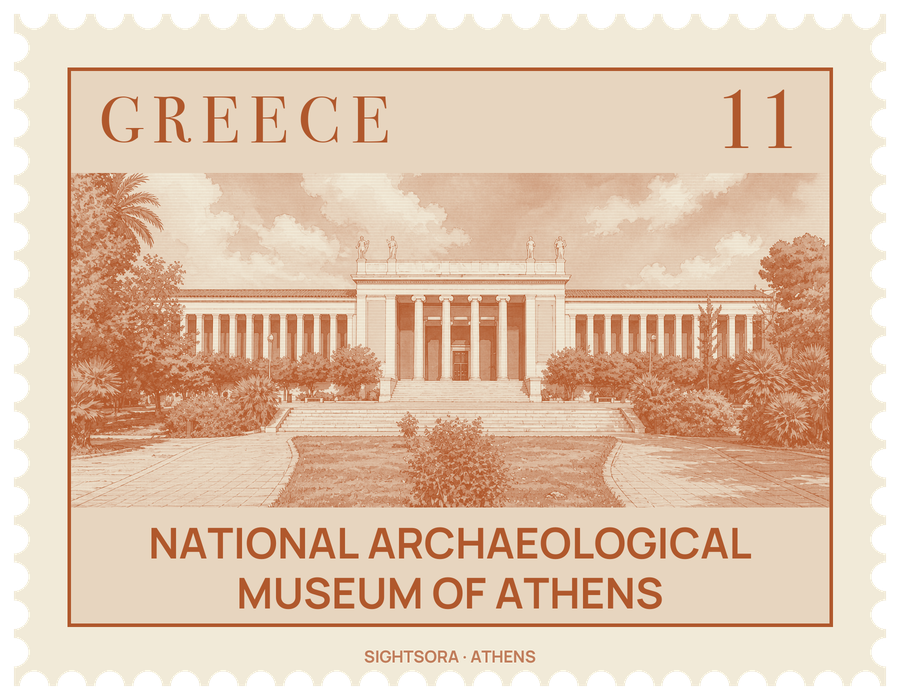
Its roots go back to a national collection founded on Aigina in 1829 by Ioannis Kapodistrias; the present building, on land given by Eleni Tositsa, went up between 1866 and 1889 to plans begun by Ludwig Lange and reworked by Panagis Kalkos, Armodios Vlachos and Ernst Ziller. In World War II the museum closed and its antiquities were packed in protective boxes and buried, and the galleries reopened in 1945.
The prehistoric galleries are the usual starting point. They hold Neolithic pottery from sites such as Dimini, a Neolithic terracotta figurine from Karditsa in Thessaly known as "The Thinker", and the marble Cycladic figurines from Keros and other Aegean islands, among them a harpist, whose spare forms later inspired artists such as Henry Moore. The Mycenaean rooms show what Heinrich Schliemann found in the grave circles of Mycenae in the 19th century: gold funeral masks, including the one wrongly named the mask of Agamemnon, along with gold cups, seals and jewellery. Nearby are the two gold cups from Vaphio decorated with the capture of a bull, and the warrior's vase from the 12th century.
Beyond prehistory, the collections run through Greek sculpture, including kouroi such as the Kroisos Kouros, funerary stelae, bronzes, painted vases, frescoes from Tiryns and Santorini, and finds from the Antikythera wreck, the Temple of Aphaea on Aegina and the Sanctuary of Artemis Orthia in Sparta. The Egyptian collection holds mummies, jewellery, a loaf of bread some 3000 years old and, as its centrepiece, the bronze figure of Takushit, a princess and priestess, about 70 cm high and covered in hieroglyphs. The Stathatos collection adds some 1000 objects, mostly jewellery, including Hellenistic gold from Karpenissi and Thessaly.
The south wing houses the separate Epigraphical Museum, devoted to inscriptions. The main building has a café in the sculpture garden and a shop selling replicas, and it is fully accessible to wheelchair users, with facilities and guides for hearing-impaired visitors.
Getting there
Victoria station on Athens Metro Line 1 is a walk of about five minutes from the museum, and buses and trolleybuses also stop nearby; the Athens Tram and the Proastiakos suburban railway do not serve it.