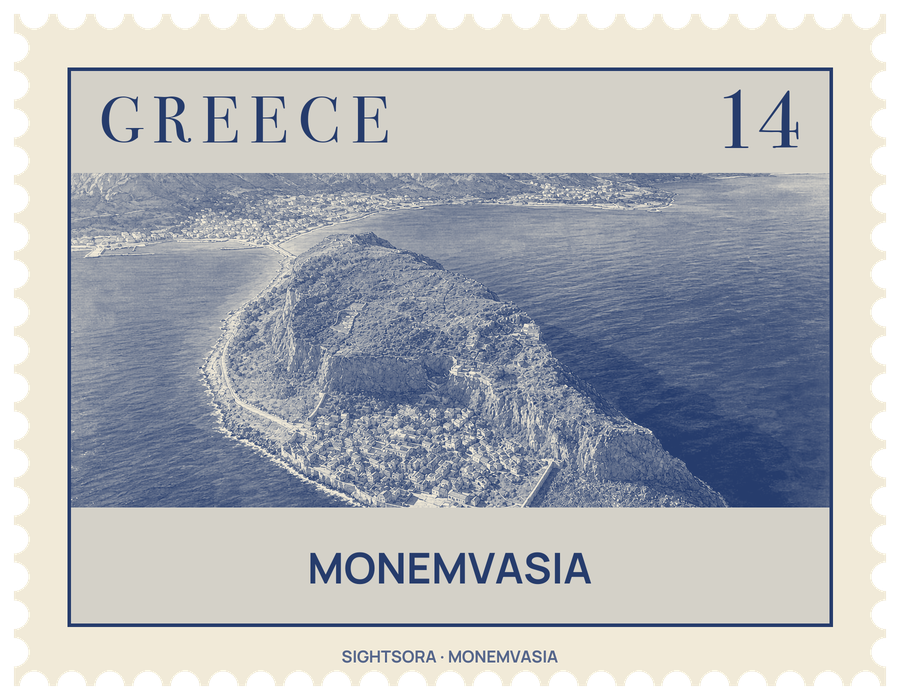
Most of the rock is a plateau about 100 metres above the sea, up to 300 metres wide and a kilometre long; the inhabited lower town clings to its southern slope, and the abandoned upper town spreads across the top. The name comes from two Greek words meaning "single approach", while Malvasia, the Italian version of the name, became attached to the Malmsey wine traded through its port.
The town was founded in the 6th century, when people from Sparta moved to this easily defended rock. Its position on the sea routes made it a prosperous trading port through the Byzantine centuries, with a golden age lasting until 1460. It then passed back and forth between Byzantines, Venetians and Ottomans, with Francesco Morosini besieging it in 1687 and Girolamo Corner taking it for Venice in 1690, before the Greeks won it in 1821 after a four-month siege. Decline followed, and by 1971 only 32 people lived in the old town. From the 1970s houses were bought and restored by visitors, and many medieval buildings now serve as hotels.
The lower town is entered through the west gate, linked by road to the bridge over the causeway. Inside, the old main street, the Byzantine Middle Street, runs past shops to Elkomenos square, where the cathedral of Christ Elkomenos faces the former mosque and the old bishop's palace, whose doorway still bears the lion of Venice. Side streets are narrow cobbled lanes, some tunnelled under houses, fit only for people on foot and donkeys. Among the many churches are the domed Panagia Chrysafitissa by the sea wall and Agios Nikolaos, built in 1703 with Western European touches. With no natural springs on the rock, the tall, narrow houses were built over cisterns that collected rainwater from the roofs.
The former mosque has held the archaeological collection of Monemvasia since 1999. Its vaulted hall shows Byzantine and later architectural sculpture, including carvings that came from Hagia Sophia and the restored marble screen of a small Middle Byzantine church found near the sea walls, along with everyday pottery, coins, lamps, glass and Venetian coats of arms.
A winding cobbled path with two intermediate gates climbs from the lower town to the fortified gate of the upper town, which has been uninhabited since the second Venetian occupation. Up on the plateau stand the church of Hagia Sophia, large public cisterns, an Ottoman fountain, a ruined 17th-century bathhouse and the remains of the acropolis, a fortress with a tower at each corner. At the eastern tip of the island stands a lighthouse built in 1896, with a small exhibition on the Greek lighthouse network.
Getting there
Since 1971 a bridge on the western side has connected the rock to the mainland road network. From the bridge a road leads to the west gate of the lower town, whose lanes are fit only for walkers and donkeys.