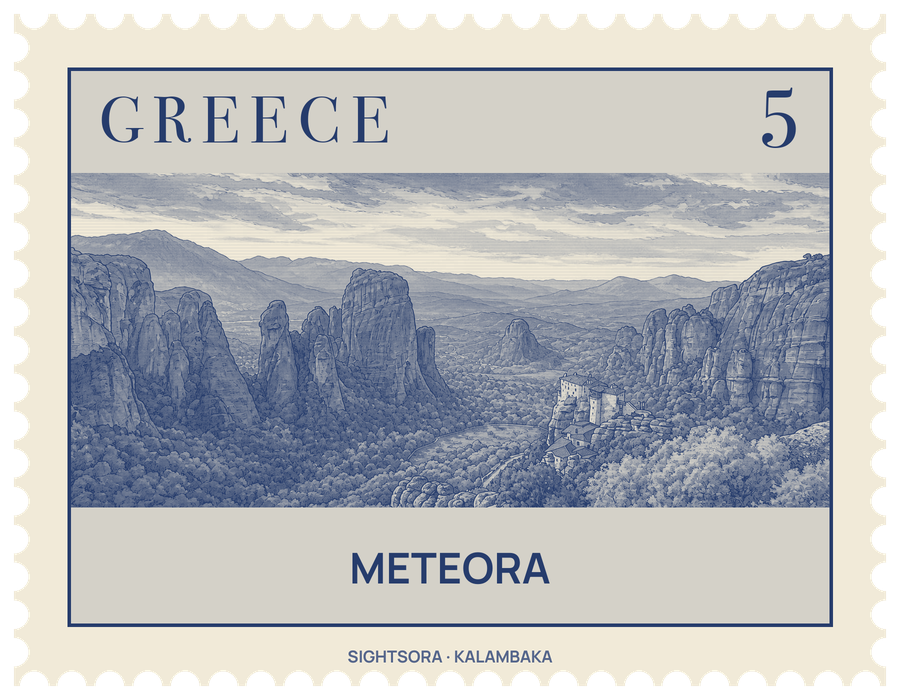
The name means "lofty" or "elevated", the same root as the word meteor. Twenty-four monasteries were founded on the rocks, most of them after the middle of the 14th century, and six survive; UNESCO listed the six as a World Heritage Site in 1988.
The pillars began to take shape about 60 million years ago, when earth movements lifted old delta deposits of stone, sand and mud into a plateau split by vertical faults; water, wind and extremes of heat and cold then wore the rock down along those cracks into free-standing towers. The rock shows few horizontal layers, which gives the columns their smooth, uniform look. People lived in caves around Meteora long before the monks: at Theopetra Cave, 4 kilometres from Kalambaka, a stone wall blocking much of the entrance was built 23,000 years ago, and radiocarbon dates show human presence going back 50,000 years.
Hermits were living in hollows and fissures of the rocks by the 800s, some of them 550 metres above the plain, and came together for worship only on certain days at a chapel at the foot of the Dupiani rock. Monasteries proper came in the 14th century, when monks wanted refuge from Turkish raids. Athanasios the Meteorite, a monk from Mount Athos, arrived in 1344 and between 1356 and 1372 founded the Great Meteoron on the Broad Rock, under the protection of Simeon Uroš, the local ruler at Trikala. For centuries the only ways up were long ladders that could be drawn in, or nets and baskets hauled up on ropes; steps were cut into the rock only in the 1920s.
The Great Meteoron, the oldest and largest of the group, has its main church dedicated to the Transfiguration, a domed kitchen beside the refectory, a hospital whose brick roof rests on four columns, and its founder's hermitage cut into the rock. Varlaam, the second largest, was rebuilt from 1517 by the brothers Theophanes and Nektarios Apsarades from Ioannina and has a museum of relics and church treasures. Rousanou sits in the middle of the site at 484 metres above sea level, with views across to the other monasteries. St. Nicholas Anapausas, on a narrow rock, is the first that pilgrims meet on the way up; its floors are stacked one above another and linked by an inner staircase, with 14th-century frescoes on the third floor.
Holy Trinity stands on its own pillar and appears in For Your Eyes Only, the James Bond film shot there in 1981. St. Stephen, on a flatter, plateau-like rock, has a main church built as late as 1798, and an old refectory turned into a museum; it became a convent of nuns in 1961. The monasteries are reached today by staircases and paths cut into the rock, and around them the pillars draw rock climbers as well as hikers, trail runners and mountain bikers.