At its centre is the cloth image of the Virgin that Catholic tradition holds was miraculously imprinted in 1531 on the tilma, or cloak, of Juan Diego, to whom she is said to have appeared on this hill. Historians describe the object as a painted cloth made in New Spain after the conquest. Pilgrims come in vast numbers all year, and above all in the days around 12 December, her feast day.
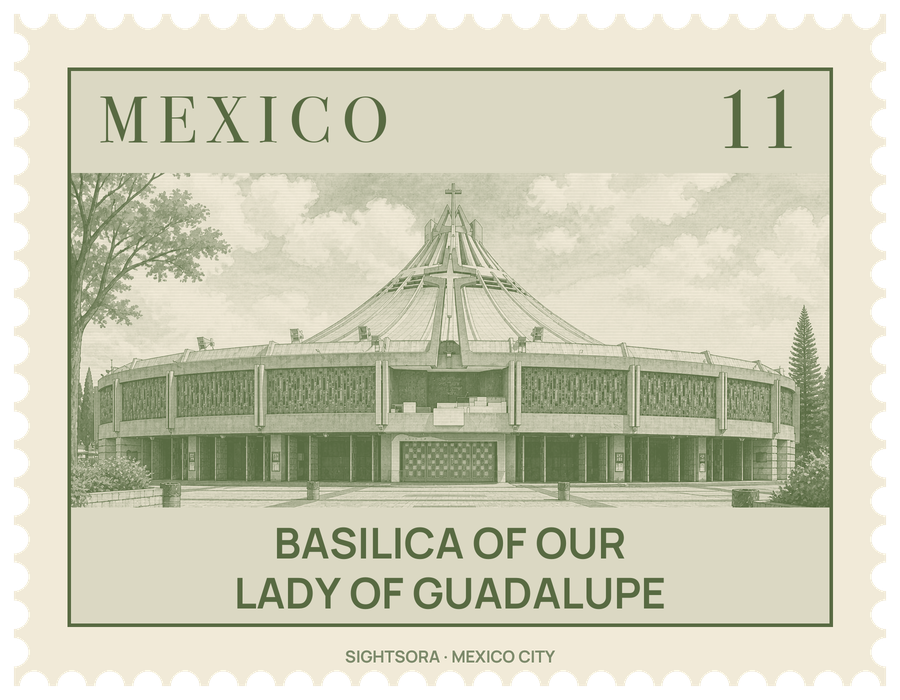
The present basilica was built between 1974 and 1976 because the old church was sinking and could no longer hold the crowds; the image was carried to it in procession on 12 October 1976. Its circular plan recalls the tent that sheltered the Ark of the Covenant, and the roof needs no internal supports, so the image, hung behind the altar beneath a large cross, can be seen from anywhere inside. A moving walkway under the altar carries visitors past it for a closer look. Above the seven front entrances is an open chapel from which mass can be said to the crowds in the vast Atrio de las Américas, and the building stands on 344 control piles meant to stop it settling.
Next door, the Old Basilica, now the Templo Expiatorio a Cristo Rey, was designed by Pedro de Arrieta and opened in 1709, with four octagonal corner towers and a dome tiled in yellow and blue Talavera. Its interior was remade in Neoclassical style in the early 19th century by Agustín Paz and Manuel Tolsá, and later given a white Carrara marble altar. In 1921 a bomb hidden in flowers exploded at the altar without destroying the image; a crucifix bent by the blast is kept in the shrine. In 1904 the church was raised to the rank of basilica.
Several chapels mark points in the tradition. The Capilla de Indios of 1649 stands over the foundations of the first churches to the Virgin, and tradition says Juan Diego lived here caring for the first shrine from 1531 until his death in 1548. Up the hill, the Capilla del Cerrito recalls the first apparition and the miracle of the flowers, with frescoes by Fernando Leal telling the story; beside it, the colonial Tepeyac cemetery holds the graves of figures such as Antonio López de Santa Anna. On the eastern slope, the small circular Capilla del Pocito, built between 1777 and 1791 by Francisco Guerrero y Torres over a well believed to work miracles, has a zigzag-patterned dome painted with Marian symbols.
In the north wing of the former Capuchin convent, the basilica's museum, opened in 1941, holds nearly 4,000 pieces of colonial art, with paintings by Cristóbal de Villalpando, Miguel Cabrera, Juan Correa and José de Ibarra, and a hall of more than 2,000 ex-votos left for the Virgin of Guadalupe.