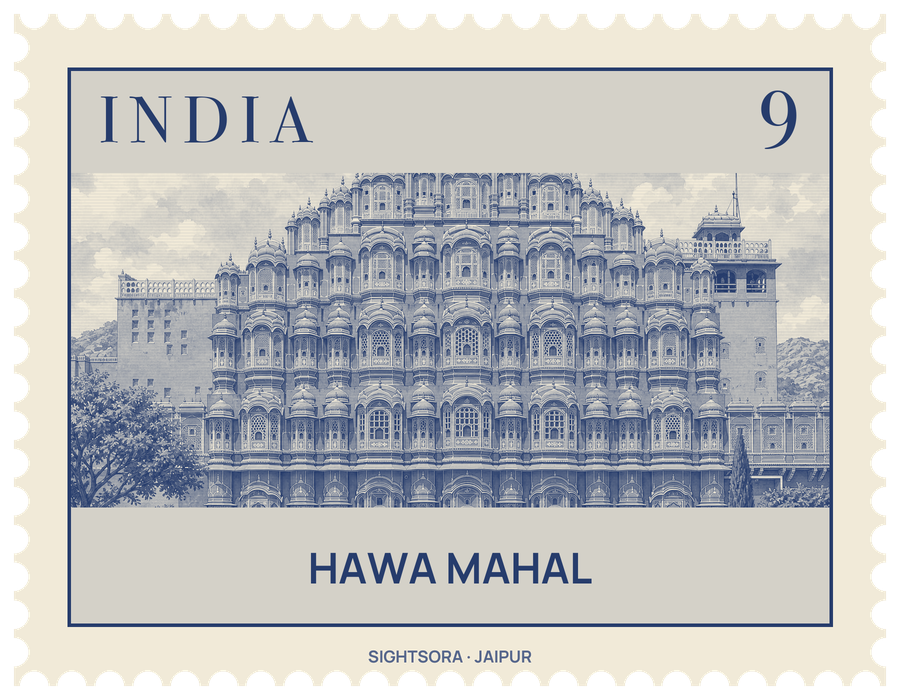
Maharaja Sawai Pratap Singh had it built in 1799; he was a grandson of Maharaja Sawai Jai Singh, the ruler who founded Jaipur. The architect was Lal Chand Ustad, and the name comes from Persian, meaning simply 'wind palace'. The building belongs to a much larger palace complex and extends to the zenana, the women's quarters.
The latticed windows, known as jharokhas, had two jobs. They let the royal women watch daily life and festival processions in the street below without being seen, and they caught the breeze: air drawn through the small openings, helped by fountains set in the middle of the chambers, kept the rooms cooler in the summer heat. The side most people photograph from the road is in fact the back of the palace, not its front.
The structure is shaped like a stepped pyramid about 15 metres high. Its top three floors are only one room deep; the lower two each open onto a patio. On the street side every bay carries tiny windows, carved sandstone grilles, finials and small domes, so that the façade reads as a mass of semi-octagonal projections; some of the jharokhas are wooden. The ornament mixes two traditions: Rajput domed canopies, fluted pillars and lotus and floral motifs alongside Mughal-style arches and stone inlay filigree. Its pink-red stone matches the city's other monuments and the name "Pink City" given to Jaipur.
From the City Palace side, an imperial door opens into a large courtyard lined on three sides by two-storey buildings, with Hawa Mahal itself closing the east side; an archaeological museum occupies this courtyard. The inner face of the building is plain by comparison, a series of pillared chambers and corridors rising to the top floor, and the two highest floors can be reached only by ramps. In some rooms coloured glass panes throw a spectrum of colours across the walls when the sun comes through. From the rear of the palace the slanting wall of the Samrat Yantra at Jantar Mantar and the tall Isarlat tower are both in view. Rajasthan's state archaeological department looks after the monument.