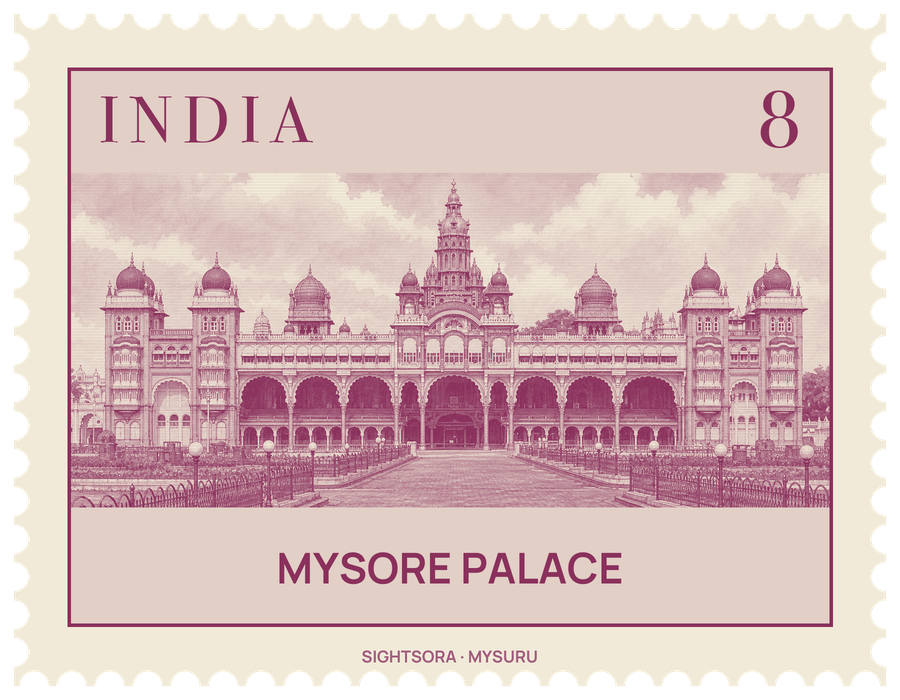
The Wadiyars lived and ruled their kingdom from here. The building seen today went up between 1897 and 1912 for the young Krishnaraja Wodeyar IV, after fire gutted the earlier palace, and its design is credited to the British architects Henry Irwin and Edwin Wolleston Fritchley. It mixes Indo-Islamic, Rajput, Hoysala and Gothic elements in the Indo-Saracenic manner. The name comes from Sanskrit: Ambā, "mother", is a title of the goddess Durga, and vilāsa means a residence of pleasure.
A fort stood on the site from the 14th century, and palaces were destroyed and rebuilt here many times. Tipu Sultan pulled down the palace in 1793 to reuse its stone for a new fortress, and after his death in 1799 the British crowned Krishnaraja Wodeyar III, then a boy of five, and rebuilt the palace, mostly in wood; from then on Mysore was the capital of the kingdom. On 20 February 1897, just after a royal wedding, fire swept through the northern part of that building, destroying the durbar hall, armoury, Sanskrit library and music room. The regent, Kempananjammanni Devi, moved the family to the nearby Jaganmohan Palace and ordered a replacement built mainly of stone, brick and iron so that little of it could burn. In the 1920s the yoga teacher Tirumalai Krishnamacharya taught in the palace, where K. Pattabhi Jois and B. K. S. Iyengar were among his pupils. On 26 January 1950 Jayachamarajendra Wadiyar read a proclamation in its Durbar Hall handing the kingdom over to the Republic of India.
The palace is three storeys high, about 75 metres long and 48 metres wide, built of red and grey-green granite. Its five-storey central tower carries the gilded dome, topped not by a finial but by a small chhatri in the style of Rajasthani palaces, and five-storey square towers with pink marble domes stand at each end. Over the great central arch of the façade sits a sculpture of Gajalakshmi, a form of Lakshmi, goddess of wealth. Bronze panthers made by a British sculptor in 1909 line the walkway at the main entrance.
Through the wrought-iron Ane Bagilu, the "elephant gate", a courtyard once used for wrestling contests during Dasara leads to the marriage hall: an octagonal pavilion under a stained-glass dome resting on cast-iron pillars made in Glasgow by Walter MacFarlane & Co., its walls hung with oil paintings of the Dasara rituals. On the first floor are the two durbar halls where the king received guests. The public Diwan-e-Aam, 47 metres long, has rows of carved granite pillars, ceilings painted with Hindu deities and works by the painter Raja Ravi Varma; the private Diwan-e-Khas has carved teak doors and marble floors with pietra dura inlay. The Dolls' Pavilion, or gombe thotti, near the entrance shows dolls and palanquins used at Navaratri together with the Golden Howdah, a gilded wooden seat weighing 750 kilograms that carries the idol of the goddess Chamundeshwari during the Dasara festivities.
The complex holds two museums. The public museum, run by the Mysore Palace Board, takes visitors through the main building's two upper floors with their durbar halls and marriage hall. The privately owned Residential Museum occupies the older rear wing, which dates from the early 19th century and largely escaped the 1897 fire; it shows paintings, toys and musical instruments, and an armoury of 725 weapons and pieces of military equipment, among them swords that belonged to Tipu Sultan, Hyder Ali and Kanthirava Narasaraja I. Yaduveer Krishnadatta Chamaraja Wadiyar, the dynasty's ceremonial head, has his living quarters in the main palace.
Gardens and Hindu temples built by Wadiyar rulers between the 16th and 20th centuries surround the palace, and unusually they face the palace rather than the east. The Lakshmiramana Temple, among the earliest of the group, saw the coronation of Krishnaraja Wadiyar III in 1799 and has a five-tiered gopuram added in 1851. The Varahaswami Temple near the southern gate is known for its carved pillars, doorways and murals from the Ramayana and Mahabharata, and the Prasanna Krishnaswami Temple of 1829 has a painted pillared hall and an image of the child Krishna crawling with a ball of butter. The Bhuvaneshwari Temple of 1951 and the Gayatri Temple of 1953 are the newest. During the nine nights of Navaratri the palace, gates and temples are lit by roughly 100,000 bulbs, and the festival ends with the Jamboo Savari, in which a dozen elephants carry the idol of Chamundeshwari out of the Balarama gate to the Bannimantap Parade Grounds.