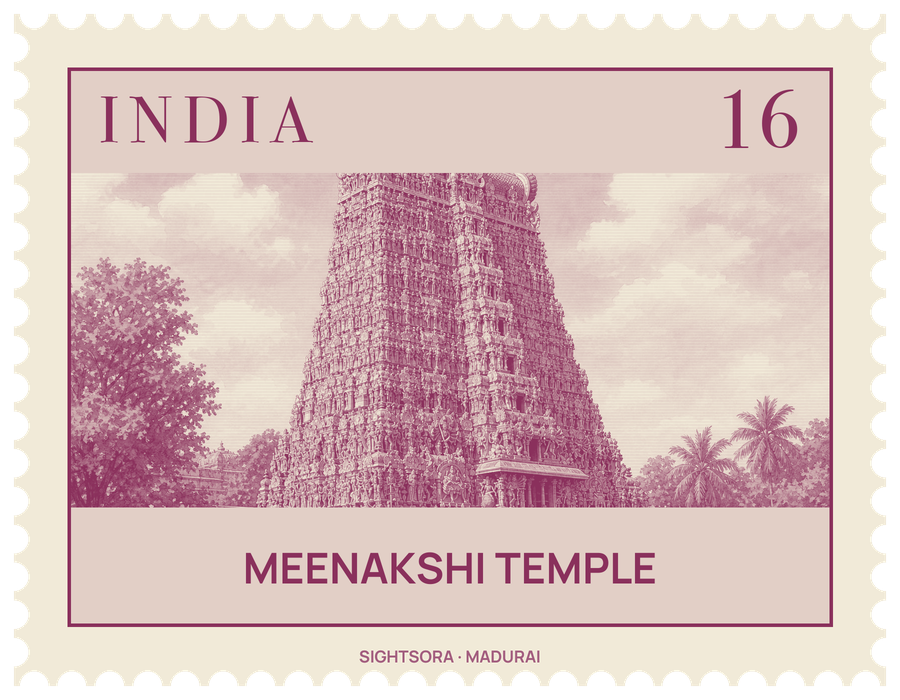
The temple honours Meenakshi, a form of the goddess Parvati, and her consort Sundareswarar, a form of Shiva, and it brings together three traditions of Hinduism, Shaivism, Shaktism and Vaishnavism: Shiva is her husband and Vishnu, in local tradition, her brother. The old city was laid out around it, with streets ringing the complex in a concentric pattern and named after months of the Tamil calendar, and the west tower is the model for the state emblem of Tamil Nadu.
According to the Thiruvilaiyadal Puranam, King Malayadhwaja Pandya and his queen prayed for a son, and a three-year-old girl rose from the sacrificial fire instead; she grew up to rule Madurai and, on meeting Shiva, revealed herself as Meenakshi, an incarnation of Parvati. For most of her devotees she, born in the city, ranks above her husband, and pilgrims usually visit her shrine before his. The earliest masonry goes back to the Pandya kings of the 12th and 13th centuries. After the temple was sacked by the armies of the Delhi Sultanate in the 14th century, the Vijayanagara rulers rebuilt it, and the Nayaks of Madurai expanded it greatly in the 16th and 17th centuries, adding most of the towers and pillared halls seen today.
The complex covers 5.7 hectares inside concentric walled enclosures, each with a gateway on all four sides, and the towers grow taller towards the outer walls. The southern gopuram, from the 16th century, is the tallest at 52 metres and carries over 1,500 mythological figures in its panels, while the eastern tower is the oldest. The Mottai or 'bald' gopuram, begun in the 16th century, stood without a roof for nearly three hundred years and has far fewer figures than the rest. Around the walls, murals show sixty-four episodes of the Thiruvilayadal, Shiva's sacred games, among them the ruin of the city and its temple and their revival.
The two main shrines stand side by side in the innermost enclosure, facing east. Meenakshi's sanctum holds a green stone image of the goddess holding a lotus on which a green parrot perches; Sundareswarar's, the largest shrine in the complex, holds a lingam under a stone cobra. Every evening, according to the temple's ritual, a pair of metal footprints representing Shiva is carried by palanquin from his sanctum to her chamber so that the couple spend the night together, and in the morning they are woken with puja. Just outside his shrine sits the large Mukkuruni Vinayakar, carved from a single stone. Six pujas are held each day to the music of nadhaswaram and tavil.
In front of Meenakshi's shrine lies the Potramarai Kulam, the golden lotus pond, 50 by 37 metres with a gilded lotus at its centre; on its western side survive fragments of 17th- and 18th-century frescoes of the divine marriage. The thousand-pillared hall in the north-east, with 985 carved pillars and rows of yali figures, houses an art museum about the temple, and just west of it stand musical pillars that ring with a note when struck. The Ashta Shakthi mandapa near the east entrance has eight forms of the goddess carved on its pillars, and the Kilikoondu mandapa, once used to keep parrots, has a yali holding a loose stone ball in its mouth. Outside the walls, the 124-pillared Vasantha or Pudu mandapa is lined with sculpture partly hidden by shopkeepers' stalls. The wedding of Meenakshi and Sundareswarar is the temple's best-attended festival, lasting 15 days, when the deities are drawn through the surrounding streets on a temple car.