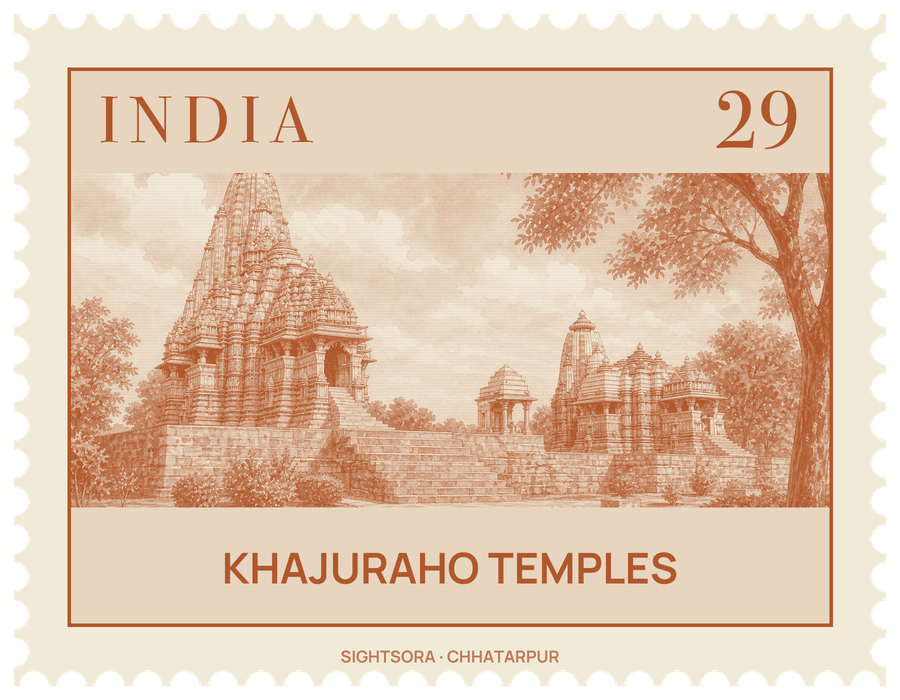
Historical records speak of 85 temples here by the 12th century; around two dozen survive, Hindu and Jain side by side, in western, eastern and southern clusters. UNESCO inscribed them as a World Heritage Site in 1986 and singles out the Kandariya Mahadeva temple, whose wealth of sculpture it counts among the finest achievements of Indian art.
The temples stayed in use until the end of the 12th century. Under later rulers some were defaced and many were left to the forest, and their remoteness spared them further harm. In 1838 a British engineer, Captain Burt, was led to them by local people and reported what he had seen to the Asiatic Society of Bengal. Alexander Cunningham's survey later sorted them into a Western group around the Lakshmana temple, an Eastern group around the Javeri temple and a Southern group around the Duladeva temple, names still in use. The name Khajuraho comes from the Sanskrit for 'date palm', and local legend says two golden date palms once stood at the gate.
Each temple follows the same plan. It rises from a high, richly carved terrace, the jagati, and visitors pass from an ornate entrance porch into a main hall, then a vestibule and finally the sanctum, the garbhagriha, with a path around it for walking in a clockwise circle. Above the sanctum climbs the shikhara, a spire built up from smaller spires clustered against the main one, each standing for Mount Kailasa, the home of the gods. All but one temple, the Chaturbhuja, face the sunrise. The builders used no mortar: the sandstone blocks lock together with mortise and tenon joints and are held by their own weight, on a granite base that is mostly hidden from view.
The Kandariya Mahadeva, a Shiva temple from the reign of King Vidyadhara, is the largest; its spire rises 116 feet above the ground, and more than 870 figures, most of them about half life size, cover it in three bands. The Lakshmana temple is linked to King Yashovarman and the Vishvanatha temple to King Dhanga. The Matangeshvara temple is still a place of worship, with a lingam 2.5 metres tall, and the Chausath Yogini temple holds images of 64 yoginis. In the eastern group, the Digambara Jain temples include the Pārśvanātha, Ādinātha and Śāntinātha temples and the ruined Ghantai temple, whose pillars are carved with bells.
The sculpture is what most visitors come to see. Gods and minor deities, scenes of worship, teachers with their pupils, dancers and musicians, potters and farmers, women applying make-up or washing their hair, and mythical creatures such as the lion-bodied vyalas fill the walls, carved finely enough to show strands of hair, nails and jewellery. Khajuraho is best known for its erotic panels, yet these make up less than a tenth of the carving; most sit within the larger scheme rather than standing out from it, and finding them takes a close look. Scholars read them in different ways, as tantric imagery or as part of the Hindu treatment of kama, love and desire, as one of the four aims of life, and the art historian Stella Kramrisch saw the embracing couples as a symbol of moksha, the final union of spirit and nature.
Getting there
Khajuraho has its own airport, Civil Aerodrome Khajuraho (HJR), and a railway station roughly six kilometres from the monuments' entrance. By road the temples lie roughly ten kilometres off National Highway 75.