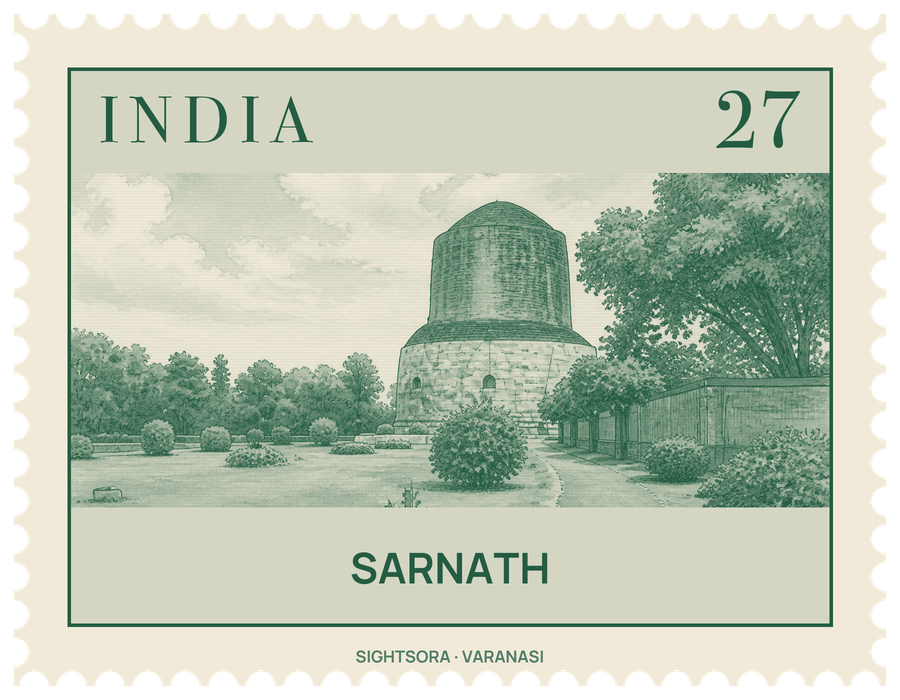
Here he taught five disciples, Kaundinya, Assaji, Vappa, Bhaddiya and Mahanama, the moment Buddhists remember as the Wheel of Dharma first being set turning, and the first Buddhist community came together. Sarnath is one of four sites the Buddha himself is said to have named as places of pilgrimage, with Lumbini, Bodh Gaya and Kushinagar, and it was inscribed as a UNESCO World Heritage Site in 2026.
The town's many names carry the story of the place. Sarnath goes back to the Sanskrit Sāranganātha, 'Lord of the Deer', after a legend in which the future Buddha, born as a deer, offered his own life to save a doe from a king's hunt; the king was so moved that he made the park a sanctuary for deer. The Pali name Isipatana is read as 'the place where holy men descended'. Buddhism flourished here for well over a thousand years, and the Chinese pilgrim Xuanzang, who came around 640 CE, wrote of some 1500 monks and of hundreds of votive stupas and little shrines.
The ruins were rediscovered by Europeans in the late 18th century and dug by a series of excavators, most notably Alexander Cunningham, who confirmed in 1836 that this was the site of the first sermon, and Friedrich Oertel, whose team found the base and shaft of the Ashokan pillar and its lion capital in March 1905. Among the remains in the deer park are the Dhamek Stupa; the foundations of the Dharmarajika Stupa, one of the few stupas here older than Ashoka; and the Dharmachakra Jina Vihar, a large monastery thought to have been built or restored in the mid-12th century for Queen Kumaradevi. About 800 metres outside the park, the Chaukhandi Stupa marks the spot where the Buddha met his five former companions; an octagonal brick tower on top was raised in 1588 by Akbar in memory of his father Humayun.
The Sarnath Archeological Museum holds the Lion Capital of Ashoka, which once topped the pillar and survived a 14-metre fall to the ground; it became the State Emblem of India. Also here are the fifth-century sandstone figure of the Buddha preaching his first sermon and the Kumaradevi inscription.
Sarnath is still a living place of worship. The modern Mulagandha Kuty Vihara, built by the Maha Bodhi Society, has frescoes by the Japanese artist Kosetsu Nosu and a replica of the preaching Buddha, and nearby grows a bodhi tree planted by Anagarika Dharmapala from a cutting of the tree at Bodh Gaya. Buddhist communities from Japan, Thailand, Sri Lanka, Tibet, China, Myanmar, Korea, Vietnam and Cambodia have each built temples and monasteries here in their own styles, and the Thai temple grounds hold a standing Buddha 24.3 metres high, unveiled in 2011 and modelled on the Buddhas of Bamiyan. Sarnath matters to Jains too: about 70 metres south-west of the Dhamek Stupa, the Sarnath Jain Tirth of 1824 is dedicated to Shreyansanatha, the 11th tirthankara, whose birthplace tradition places at Singhpur, a village close by. Away from the shrines, the town also has a turtle breeding and rehabilitation centre as well as the Sarnath Deer Park and Fish Canal.