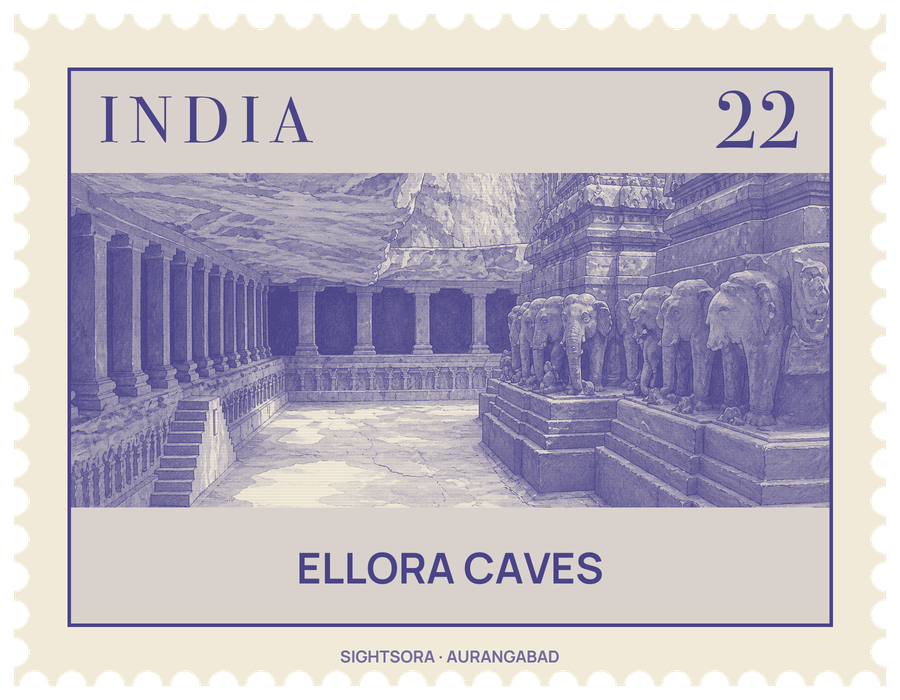
Of more than 100 excavations at the site, 34 numbered caves form the main sequence: 12 Buddhist caves at the southern end (caves 1 to 12), 17 Hindu caves in the middle (13 to 29) and 5 Jain caves to the north (30 to 34). Their artwork spans roughly AD 600 to 1000, with Jain work continuing later, and the site is a UNESCO World Heritage Site protected by the Archaeological Survey of India.
Most of the Buddhist caves are viharas, monasteries of several storeys with prayer halls, living and sleeping quarters and kitchens cut into the cliff, with shrines holding carvings of the Buddha and bodhisattvas. Cave 10, the Vishvakarma cave, is the one true prayer hall among them. Its ceiling is carved with ribs that copy wooden beams, which earned it the name 'Carpenter's Cave', and 28 octagonal columns lead to a stupa fronted by a seated Buddha 15 feet tall, teaching, with a Bodhi tree carved behind him. Caves 11 and 12, Do Thal and Tin Thal, rise three storeys and are covered with mandalas, goddesses and bodhisattvas of Vajrayana Buddhism.
Cave 16, the Kailasha temple, is the reason many people come. Dedicated to Shiva and named after Mount Kailasha, it is a complete free-standing temple, with gateway, assembly hall, shrines, a sanctum with a linga and a spire, carved downward and inward from one mass of rock; the courtyard measures 82 by 46 metres at the base and the cliff walls stand 30 metres high, and the whole covers twice the area of the Parthenon. Its construction is credited to the Rashtrakuta king Krishna I. A statue of the bull Nandi stands on a porch facing the shrine, and long panels on the main temple walls tell the two great epics, the Ramayana along the southern wall and the Mahabharata along the northern one, while the basement carries twelve scenes from Krishna's childhood.
The other Hindu caves are just as worth the walk. Cave 29, the Dhumar Lena, one of the earliest and largest, was built around the Vale Ganga waterfall, which can be seen from a balcony cut into the rock. Cave 21, the Rameshwar, has the seven mother goddesses flanked by Ganesha and Shiva and large figures of the river goddesses Ganga and Yamuna at its entrance. Cave 15, the Dashavatara, shows the ten avatars of Vishnu on its upper floor; the panel of Vishnu as the man-lion Narasimha bursting from a pillar to seize Hiranyakashipu is regarded by Coomaraswamy as its finest, and an inscription of the Rashtrakuta ruler Dantidurga is cut into its front hall.
The Jain caves of the Digambara sect at the northern end are smaller but finely detailed. The Chhota Kailasha (cave 30) echoes the great temple and has two reliefs of a dancing Indra with eight and twelve arms. The Indra Sabha (cave 32) has two storeys around a court where a shrine stands carved from a single block, a lotus carved on its ceiling and, upstairs, the goddess Ambika on her lion beneath a mango tree heavy with fruit. The Jagannatha Sabha (cave 33) is held up by twelve massive pillars, with carved elephant heads reaching out towards its porch, with the tirthankaras Parshvanatha and Mahavira inside. On the hill north-east of the caves, reached by six hundred steps, a Jain temple still in worship holds a 4.9-metre image of Parshvanatha. The carvings were once covered in painted lime plaster, and traces of paint survive in places.