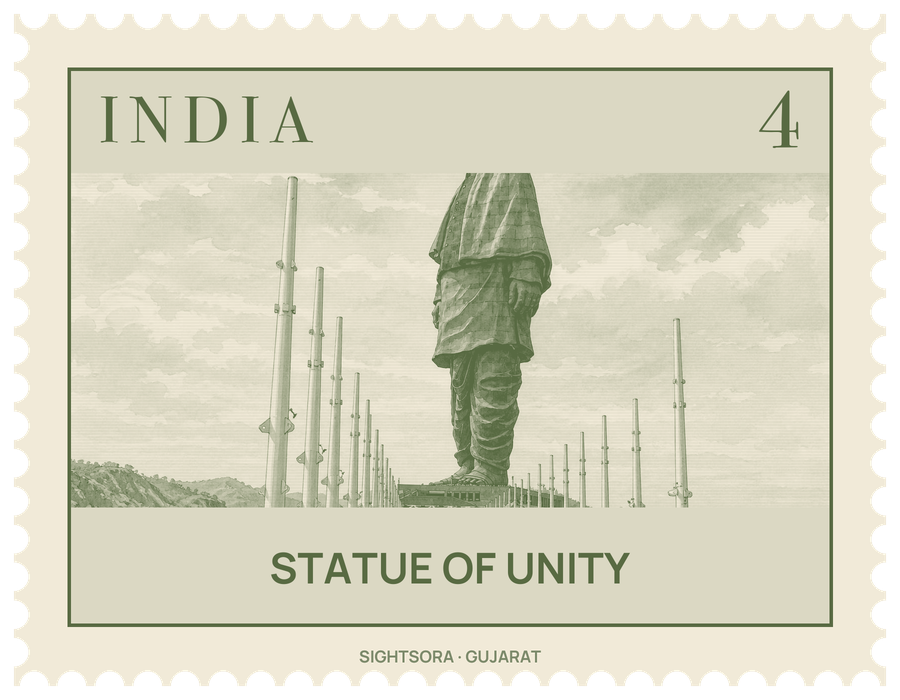
Patel (1875–1950), India's first deputy prime minister and home minister after independence, is remembered for his part in the political integration of the country, and the statue takes its name from that role. Including its base, the whole structure reaches 240 metres, and it can be seen from 7 kilometres away. The site lies 100 kilometres southeast of Vadodara.
The sculptor Ram V. Sutar based the design on his statue of Patel at Ahmedabad International Airport, showing him in a dhoti and sandals. Narendra Modi, then Chief Minister of Gujarat, laid the foundation stone on 31 October 2013; Larsen & Toubro built it, with a concrete and steel core and an outer skin of bronze panels cast at a foundry in China, and Modi, by then Prime Minister, inaugurated it on 31 October 2018, Patel's 143rd birth anniversary. For the foundation, farmers across the country were asked to donate old farm tools, and about 109 tonnes of the collected scrap iron went into it. The height of 182 metres equals the seat count of the Gujarat Legislative Assembly. Before the opening, members of the local Tadvi tribe and several villages protested over the land taken for tourism development around the statue; the Gujarat government accepted most of their demands.
Inside, the statue is divided into five zones, three of them open to the public. The lowest, reaching to Patel's shins, holds an exhibition area, a memorial garden and a museum on his life, with an audio-visual gallery that also presents Gujarat's tribal culture. Each of the two concrete towers forming the legs holds two lifts, which carry visitors in just over 30 seconds to a viewing gallery high in the statue that holds up to 200 people. Above it lie a maintenance zone and the head and shoulders.
Around the island, an artificial lake 12 kilometres long, held back by the Garudeshwar weir further down the Narmada, surrounds the statue and its grounds, which cover more than 2 hectares. A bridge links Sadhu Bet with the mainland.