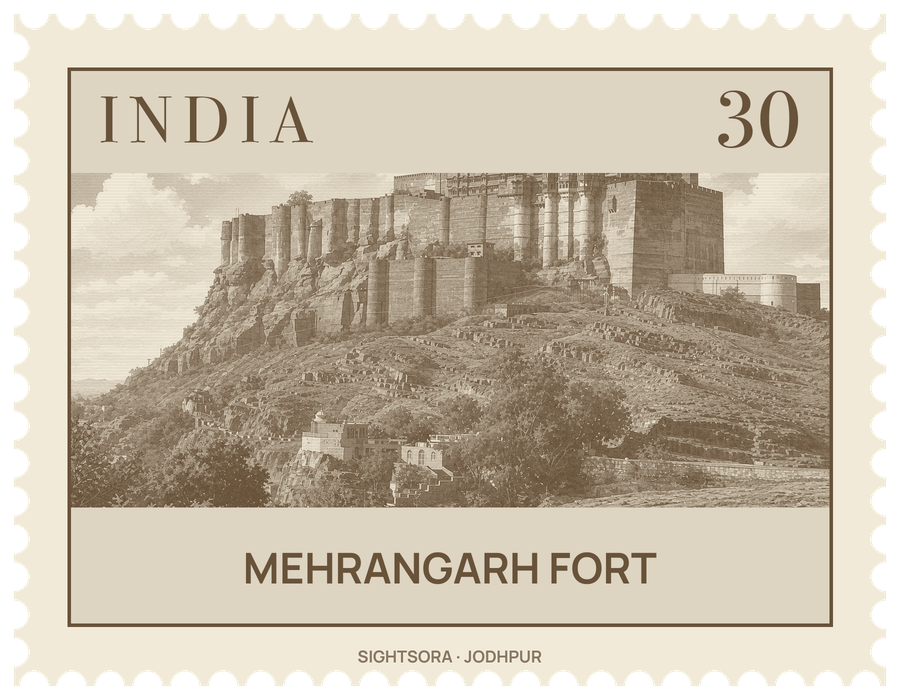
Rao Jodha, chief of the Rathore clan, laid out the fort in 1459 when he moved the capital of Marwar from Mandore, 9 kilometres to the north, to this safer site; most of what stands today, though, dates from the reign of Maharaja Jaswant Singh in the 17th century. The name goes back to Mihirgarh, 'fort of the sun', a nod to the Rathores' claimed descent from the sun god Surya.
Legend surrounds the founding. The hill, known as Bhakurcheeria, the mountain of birds, was home to a single hermit, Cheeria Nathji, who refused to leave until Karni Mata, a warrior sage from Deshnoke, came at the king's request; he went, but cursed the fort with a lasting shortage of water, and Rao Jodha built him a house and a temple inside the walls to make amends. Tradition holds that Karni Mata laid the foundation stone herself.
A winding road climbs from the city to the gates, where folk musicians often play. Seven gates lead into the fort in sequence. Jai Pol, the 'gate of victory', was built by Maharaja Man Singh in 1806 after his war with Jaipur and Bikaner, and Fateh Pol marks a victory over the Mughals in 1707. Dedh Kangra Pol still carries the scars of cannonballs fired by the Jaipur army. Beside Loha Pol, the last gate before the main complex, are the handprints of royal women who committed sati after their husbands died, and Suraj Pol, the innermost, opens onto the palace courtyards.
Inside lie the Moti Mahal (Pearl Palace), the Phool Mahal (Flower Palace), the Sheesha Mahal (Mirror Palace), the Sileh Khana and the Daulat Khana, known for detailed carving and broad courtyards. The museum spreads through them. Its galleries show elephant howdahs, wooden seats sheathed in embossed gold and silver with a front place for royalty and a rear one for a bodyguard; palanquins used by noblewomen until the second quarter of the 20th century; Marwar paintings; turbans of the many communities and festivals of Rajasthan; and the Shahi Lal Dera, a royal red tent. The armoury holds jewelled shields, jade and ivory sword hilts and guns worked in gold and silver, along with Rao Jodha's khaanda, a sword of over 3 kg, and swords attributed to Akbar and Timur. The Daulat Khana gallery keeps fine and applied art from the Mughal period, when the Jodhpur rulers stayed close to the Mughal court.
Old cannons, the Kilkila among them, still line the ramparts, which look out over much of the city. The Chamunda Mataji Temple houses the goddess whose idol Rao Jodha brought from Mandore in 1460; she remains the royal family's adopted goddess and draws large crowds during Dussehra. In the north-east corner stands a chhatri marking where Kirat Singh Sodha, a soldier, was killed defending the fort. The fort also has restaurants, exhibitions and craft bazaars.
The rock beneath the fort, a contact within the Malani Igneous Suite, is protected as a National Geological Monument, a designation given by the Geological Survey of India. Next to the fort, the Rao Jodha Desert Rock Park covers 72 hectares of rocky ground replanted with native desert vegetation among outcrops of rhyolite, welded tuff, breccia and sandstone; it has a visitors centre with an interpretation gallery, a native plant nursery and a cafe.