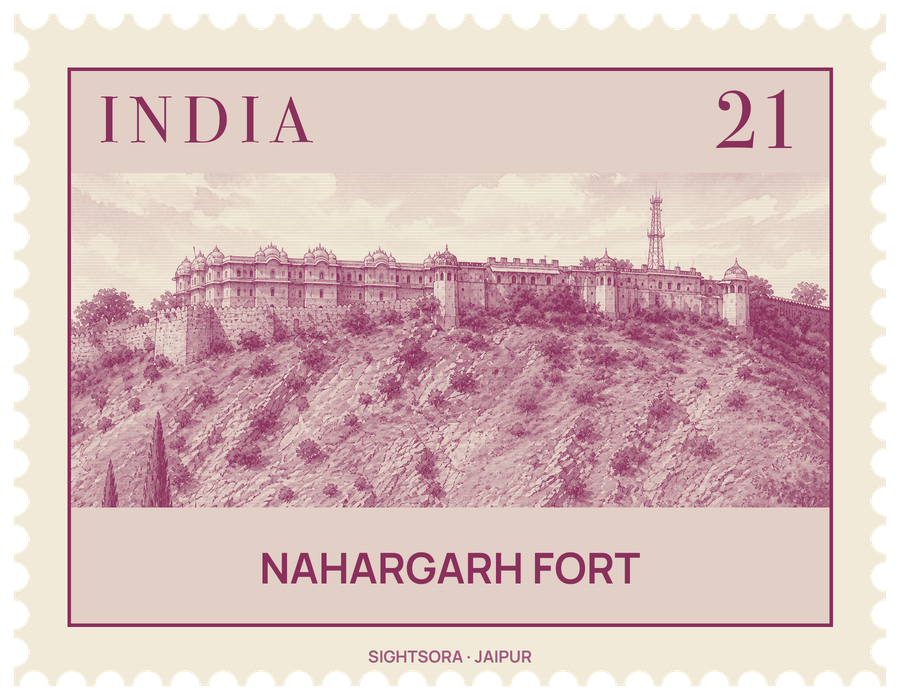
Maharaja Sawai Jai Singh built most of it in 1734 as a retreat on the summit above his new capital, and lines of walls ran across the neighbouring hills to link it with Jaigarh, which guards Amber, the earlier capital. With Amber Fort and Jaigarh, it made up a defensive ring around the city.
Its first name was Sudershangarh. The one that stuck, Nahargarh, is read as 'abode of tigers', but local tradition links it to Nahar Singh Bhomia, whose spirit is said to have haunted the ridge and hindered the builders until a temple to him was raised inside the fort. The fort was never attacked. During the uprising of 1857, Sawai Ram Singh, the king of Jaipur, sheltered the region's Europeans here, among them the wife of the British Resident.
Sawai Ram Singh enlarged the fort in 1868, and from 1883 Dirgh Patel added a range of palaces. The main one, Sawai Madho Singh's Madhavendra Bhawan, has a set of suites for the queens of Jaipur with the king's own suite at its head; corridors join the rooms, and some fine frescoes survive on the walls. The maharajas also used Nahargarh as a hunting residence. Bastions still show their cannon embrasures and gunports, and until April 1944 a gun fired from the fort gave Jaipur its official time signal, taken from the sundial of the Jantar Mantar observatory.
Dense deciduous forest surrounds the fort; it belongs to the Nahargarh Biological Park, home to many wild animals, which is why visitors are advised not to linger on the hill after the gates close in the evening. Film fans may recognise the fort from scenes in Sonar Kella, Rang De Basanti and Shuddh Desi Romance.