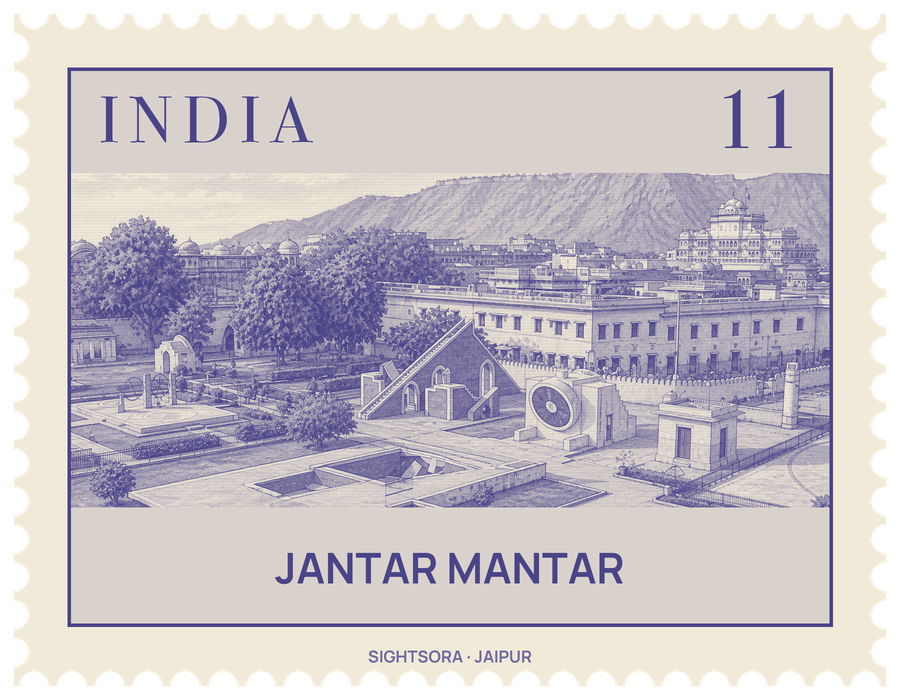
Sawai Jai Singh, the Rajput king who founded Jaipur, had it built so that the positions of the sun, moon, planets and stars could be read with the naked eye; several instruments were standing by 1728, and work went on until 1738. The name joins two Sanskrit words, yantra (instrument) and mantrana (to consult or calculate), so it means roughly 'calculating instrument'. It is listed as a UNESCO World Heritage Site.
Jai Singh had found that the astronomical tables of his day, known as the Zij, gave positions that did not match what could be seen in the sky. He built five observatories in different cities to produce better ones, and Jaipur became his main observatory, with at least 23 astronomers at work here in 1735. The resulting tables, the Zij-i Muhammad Shahi, were used in India for a century, though they drew mainly on older tables such as those of Ulugh Beg and Philippe de la Hire. After his death in 1743 the site was neglected, at one point turned into a gun factory under Pratap Singh, and later restored under Ram Singh in 1876 and Madho Singh II in 1901; it became a national monument in 1948.
The instruments cover the three classical ways of plotting the sky: against the local horizon, against the celestial equator and against the ecliptic. Built from local stone and marble, with bronze tablets, brick and mortar, each carries a scale, usually marked on its marble lining. Among them are the Jai Prakash Yantra, two hemispherical bowls with marked marble slabs that map an inverted image of the sky and that the observer can walk inside; the Rashi Valaya Yantra, twelve gnomon dials, one for each constellation of the zodiac; and the Yantra Raj, a bronze astrolabe 2.43 metres across used to calculate the Hindu calendar.
The centrepiece is the Vrihat Samrat Yantra, the 'great king of instruments', a sundial 27 metres high whose face is tilted at 27 degrees, the latitude of Jaipur. Its shadow travels at about 1 mm per second, roughly a hand's width each minute, and eclipses and the arrival of the monsoon were proclaimed from the small Hindu chhatri on its top. Nearby, the Shastansh Yantra sits in a dark chamber where at noon a pinhole image of the sun falls on a scale, and the smaller Laghu Samrat Yantra measures time less precisely at the same angle. The great size of the instruments was meant to improve accuracy, but the sun's blurred shadow edge can be 30 mm wide, and sinking foundations have since pulled some instruments out of alignment.