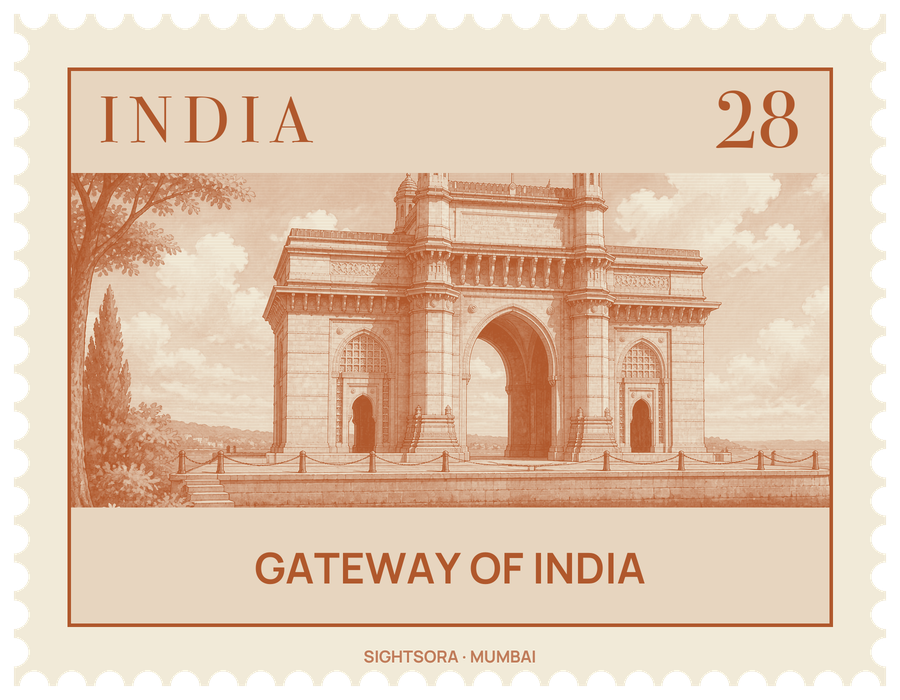
The Gateway of India marks the landing here of King George V and Queen Mary on 2 December 1911, the first visit to India by a reigning British monarch; at the time they saw only a cardboard model, because building had not yet started. Since it went up, it has been one of the first structures seen by anyone arriving in the city by sea.
The foundation stone was laid on 31 March 1913, George Wittet's final design was approved in August 1914, and land was reclaimed from what had been a fishing ground, with a new sea wall, before the arch was finished in 1924. The Viceroy, Rufus Isaacs, Marquess of Reading, opened it on 4 December 1924. It served as a ceremonial entrance for senior officials of British India, and after independence the last British troops to leave the country, the Somerset Light Infantry's First Battalion, marched out through it with a 21-gun salute, marking the end of the Raj.
Wittet worked in the Indo-Saracenic style and borrowed much of the detail from 16th-century Gujarati architecture; the façade recalls Gujarati mosques such as the Jama Mosque in Ahmedabad, while the plan, with eight piers, follows the pattern of a triumphal arch. Three arched passages cross the long sides and one the short sides. The central arch is the tallest and widest, with an extra storey crowned by four turrets, and under its dome, 15 metres across, the ceiling is worked with muqarnas. Bands of carved ornament run across the outside, and pierced stone jali screens, brought from Gwalior, surround the smaller arches. Behind the arch, steps lead down to the water. Money ran short before an approach road could be built, which is why the Gateway sits at an angle to the street that leads to it.
Facing the monument in its grounds stands a statue of Shivaji, the 17th-century Maratha warrior-king, unveiled on Republic Day, 26 January 1961, in place of an earlier bronze of George V; a statue of Swami Vivekananda stands nearby. The plaza is a busy meeting place for local people, street vendors and photographers, and since 2003 the city's Jewish community has gathered here every year to light the Hanukkah menorah.
Five jetties line the waterfront around the Gateway. The second and third serve commercial ferries, and boats from them take visitors to the Elephanta Caves, about fifty minutes across the harbour, as well as to Rewas, Mandwa and Alibaug; harbour cruises also leave from here.