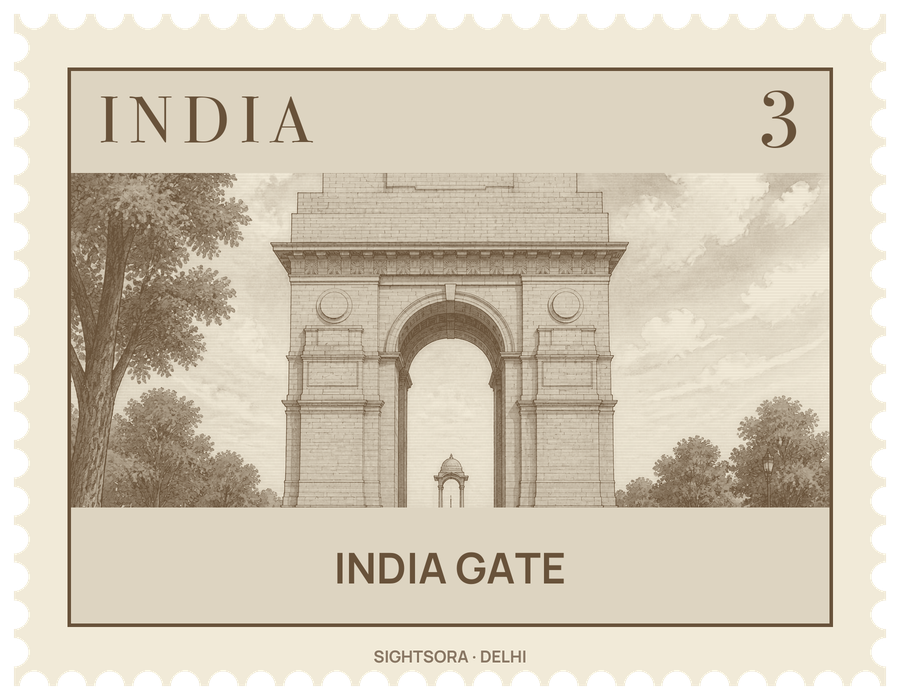
Built as the All India War Memorial, it honours 74,187 men of the British Indian Army killed from 1914 to 1921 in France and Flanders, Mesopotamia, Persia, East Africa, Gallipoli and elsewhere, and in the Third Anglo-Afghan War of 1919. Edwin Lutyens, the main architect of New Delhi, modelled it on the triumphal arches of ancient Rome, and it is often compared with the Arc de Triomphe in Paris.
The Duke of Connaught laid the foundation stone on 10 February 1921, and the Viceroy Lord Irwin opened the memorial on 12 February 1931. Lutyens, who also designed the Cenotaph in London, kept the arch free of religious symbols. It rises in stages from a low base of red Bharatpur stone to a frieze of sunburst motifs and a heavy cornice, crowned by a shallow domed bowl intended to hold burning oil on anniversaries. Large arches pierce the long sides, smaller ones the short sides, and the undersides are lined with coffers.
Across the top, the word INDIA is flanked by the dates MCMXIV and MCMXIX, above a dedication to the dead of the Indian armies. The walls carry 13,313 names, 12,357 of them Indian; they can also be looked up on the Commonwealth War Graves Commission website, with each soldier's unit and the place of the name on the gate.
About 150 metres east of the arch, at a junction of six roads, stands an empty-looking stone canopy that Lutyens based on a sixth-century pavilion at Mahabalipuram. From 1936 it sheltered a marble statue of King-Emperor George V, which became a target for independence activists and was moved in 1968 to Coronation Park. In 2022 a statue of Subhas Chandra Bose was unveiled near the India Gate.
After the 1971 war that created Bangladesh, the Amar Jawan Jyoti, the "Flame of the Immortal Soldier", was set beneath the arch: an upturned rifle topped by a helmet on a black marble base, with four flames around it, inaugurated by Indira Gandhi on 26 January 1972. It was India's memorial to the unknown soldier until 2022, when its flame was merged with the one at the National War Memorial, completed in 2019 in the hexagon around India Gate. Each Republic Day the Prime Minister pays tribute at the National War Memorial before the parade, which passes around the arch.