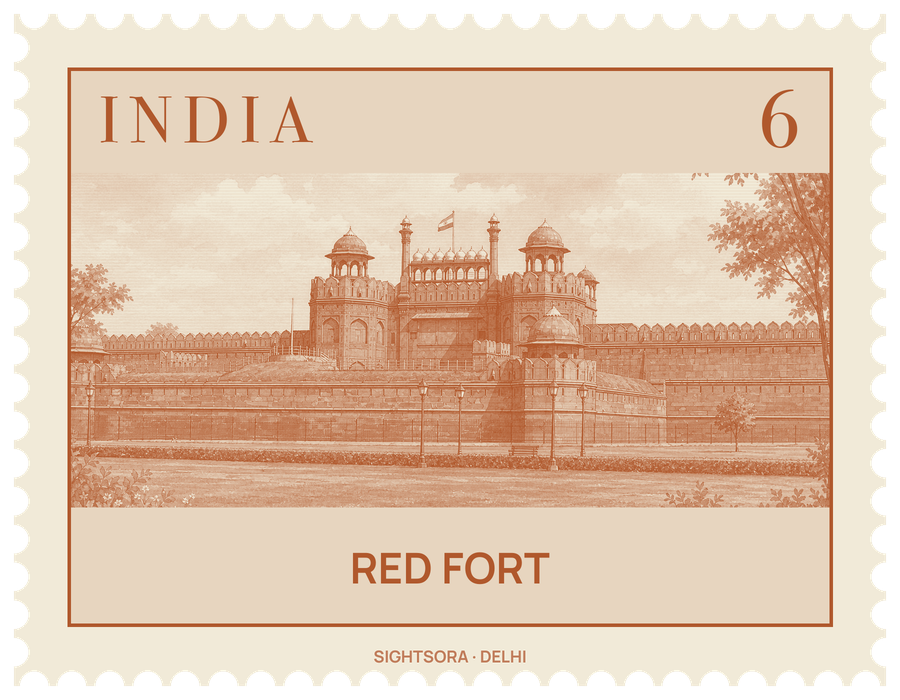
Finished on 6 April 1648 and designed, by tradition, by Ustad Ahmad Lahori, architect of the Taj Mahal, it was the residence of the Mughal emperors and the centrepiece of their new city of Shahjahanabad, today's Old Delhi. Its first name was Qila-i-Mubarak, the "Blessed Fort"; Lal Qila, "Red Fort", comes from the colour of the walls. As part of the Red Fort Complex it became a UNESCO World Heritage Site in 2007.
The fort's later history left deep marks. The Persian ruler Nadir Shah plundered it in 1739 and carried off the Peacock Throne, and in 1760 the Marathas stripped the Diwan-i-Khas of its silver ceiling and melted it down to fund the defence of Delhi. Bahadur Shah Zafar, the last Mughal emperor to live here, became a figurehead of the 1857 rebellion; afterwards the British tore down most of the inner buildings, including the harem apartments and gardens, and put up stone barracks in their place, while the walls and the marble pavilions along the river survived. On 15 August 1947 Jawaharlal Nehru raised the Indian flag above the Lahori Gate, and every Independence Day since, the Prime Minister has hoisted the flag there and spoken from the ramparts.
Visitors enter, as the public did in Mughal times, through the Lahori Gate, named for its orientation towards Lahore and screened by a barbican that Aurangzeb added. It opens into the Chhatta Chowk, a vaulted covered bazaar that once sold silk and jewellery to the imperial household and is still lined with shops. Beyond it stands the Naubat Khana, the drum house where music was played at set times, with the Indian War Memorial Museum on its upper floor. The southern Delhi Gate, similar in plan, is flanked by two life-sized stone elephants facing each other.
The Diwan-i-Aam, the Hall of Public Audience, is a hall of columns and scalloped arches where the emperor sat on a raised marble balcony to hear petitions from commoners. Behind it, along the riverfront, stand the private pavilions: the Mumtaz Mahal, which houses the Red Fort Archaeological Museum; the Rang Mahal, the "Palace of Colors", with a marble pool once fed by the water channel called the Nahr-i-Bihisht, the "River of Paradise"; the Khas Mahal, the emperor's apartment, with the octagonal Muthamman Burj tower from which he showed himself to crowds by the river; and the white marble Diwan-i-Khas, inlaid with precious stones, where the Peacock Throne once stood and where a couplet by the poet Amir Khusrow about paradise on earth is carved above the outer arches. Nearby are the domed imperial baths, lit by coloured glass skylights, and the small three-domed Moti Masjid, the Pearl Mosque, built in white marble in 1659 for Aurangzeb's private prayers.
To the north, the Hayat Bakhsh Bagh, the "Life-Bestowing Garden", has the white marble Sawan and Bhadon pavilions at either end of its canal and the red sandstone Zafar Mahal, added by Bahadur Shah Zafar around 1842, in the middle of its reservoir. The baoli, a step-well with two flights of stairs down to the water, survived the British demolitions; its chambers later served as a prison for officers of the Indian National Army when they were tried at the fort in 1945–46. Some of the British barracks now hold museums opened in 2019, on the 1857 rebellion, the Jallianwala Bagh massacre, the Indian National Army movement and Subhas Chandra Bose, and Indian art.