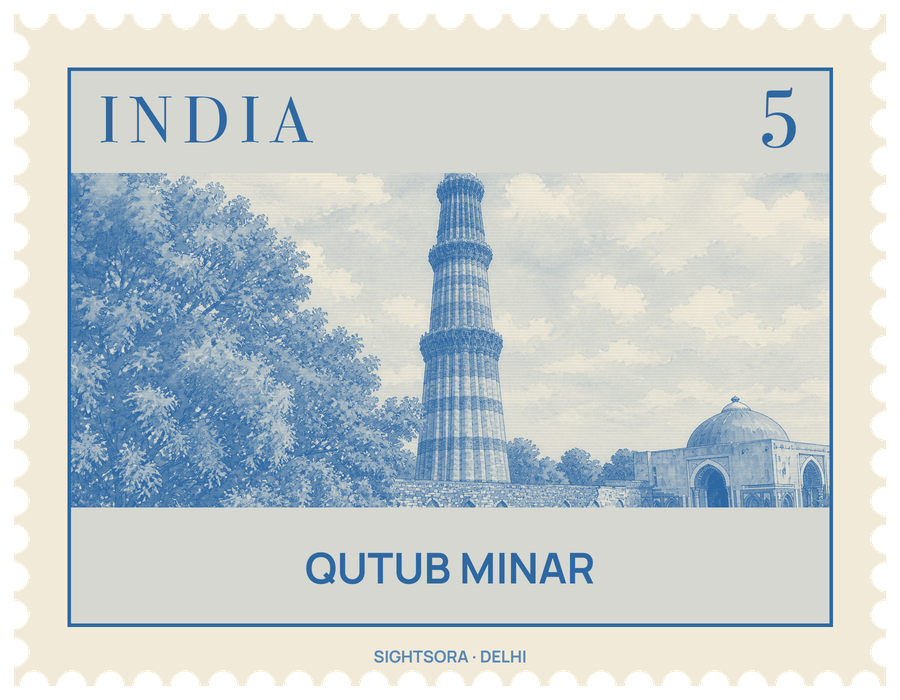
Qutb-ud-din Aibak, who went on to found the Delhi Sultanate, began it in 1199 after the Ghurid conquest of Delhi, as a minaret and victory tower marking the start of Islamic rule in the region. It is usually thought to be named after him, though it may instead honour the 13th-century Sufi saint Khwaja Qutbuddin Bakhtiar Kaki, whom his successor Iltutmish revered. The tower and the monuments around it together make up the Qutb complex, inscribed by UNESCO as a World Heritage Site in 1993.
Each story was the work of a different ruler, and the differences show. Aibak completed only the lowest, whose surface alternates twelve rounded and twelve angular ribs; Iltutmish added the next three. After lightning struck in 1369, Firuz Shah Tughlaq rebuilt the top, splitting the damaged fourth story into two and facing them in white marble, so the upper levels are plainer than the rest. Balconies on muqarnas brackets ring the shaft between the stories, and bands of carved naskh inscriptions, with Qur'anic verses and the names and titles of Ghurid sultans, wrap the lower levels. The tower narrows from 14.3 metres across at the base to 2.7 metres at the top, and it leans just over 65 centimetres from vertical, a tilt considered within safe limits.
The builders were largely Hindu craftsmen working under Muslim architects, and the scholar Ved Parkash described the tower as an early fusion of Hindu and Muslim traditions. Since some of the carvers did not know the Qur'an, parts of the Arabic inscriptions are out of order. Inscriptions in Persian-Arabic and Nagari document the later repairs under Firuz Shah Tughlaq and Sikandar Lodi, who restored the tower after an earthquake in 1505.
At the foot of the tower lies the Quwwat-ul-Islam Mosque, begun by Aibak in 1199: a rectangular courtyard enclosed by cloisters whose carved columns came from 27 Jain and Hindu temples that, according to Aibak's own inscription on the eastern entrance, he had demolished. A tall arched screen was added later, and the mosque was enlarged by Iltutmish and Ala-ud-Din Khalji. In its courtyard stands the Iron Pillar, whose Sanskrit inscription in Brahmi script from the fourth century records that it was raised as a standard of the god Vishnu in memory of a king named Chandra.
East of the tower, a small pillared cupola stands on the ground, known as Smith's Folly. Major Robert Smith, a British Indian Army officer, put it on top of the minaret as a sixth story while repairing earthquake damage in 1828; it was taken down in 1848 and reset where it stands today. The tower itself can only be admired from outside: after a stampede on the dark staircase in 1981 killed 45 people, most of them schoolchildren, it was closed to the public.