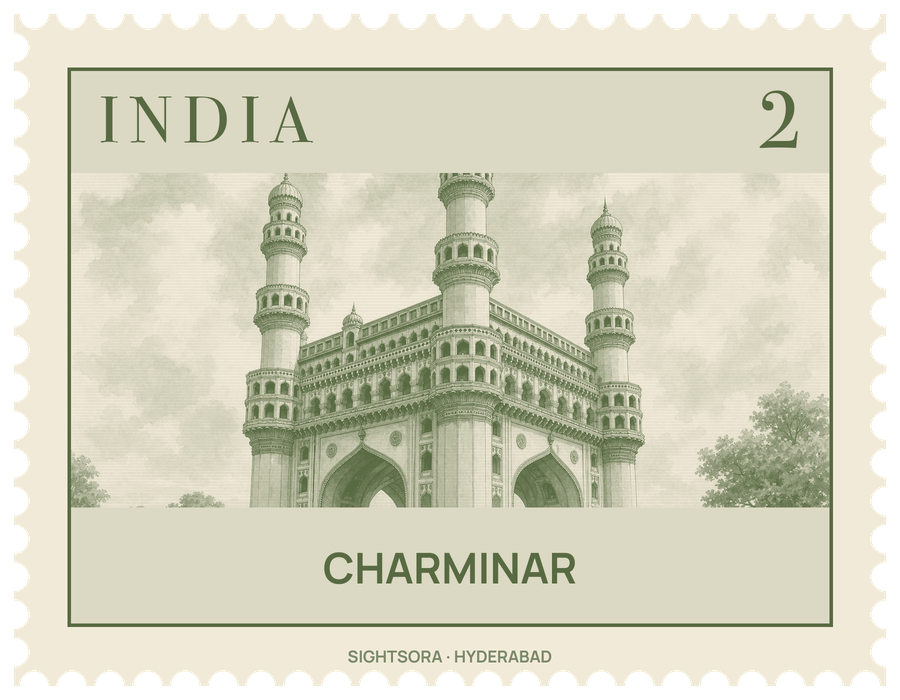
Its name joins the Urdu words for "four" and "minaret". Muhammad Quli Qutb Shah, fifth ruler of the Qutb Shahi dynasty, built it in 1591 after moving his capital from Golconda to his new city of Hyderabad, and it stands on the east bank of the Musi River. Today it appears on the emblem of Telangana and is looked after by the Archaeological Survey of India.
Why it was built is debated. The Archaeological Survey of India records that it is widely held to mark the end of a plague, while the 17th-century French traveller Jean de Thévenot linked it to the start of the second Islamic millennium. Either way, the old city was laid out around it in four quarters, at the crossing of a trade route that ran to the port of Machilipatnam, and its four great arches each opened onto one of the busiest royal streets.
The structure is 20 metres on each side, with an arch facing each cardinal point and the minarets built into the body of the building rather than standing apart. Each minaret has a double balcony, and the whole surface is worked with stucco ornament, balustrades and balconies. A climb of 149 winding steps leads up through two galleries, one above the other, to the open roof. A mosque occupies the western end of the top floor, with 45 covered prayer spaces and an open area in front for large congregational prayers, and a small cistern with a fountain for ablutions sits in the middle; the Qutb Shahi court once met on the remaining part of the roof. The clocks on the four faces were added in 1889, under the sixth Nizam, Mir Mahbub Ali Khan.
The streets around the monument are as much a part of a visit as the building itself. Laad Bazaar, to the west, is known for jewellery and especially bangles, and the nearby Pathargatti boulevard for pearls; in its heyday the Charminar market counted some 14,000 shops, and Sarojini Naidu wrote about them in her poem "In the Bazaars of Hyderabad". To the southwest stands the Makkah Masjid, the city's main mosque, whose central arch was built with bricks made from soil brought from Mecca. North of the Charminar, four arches built at the same time, the Char Kaman, frame the Gulzar Houz fountain at their centre.
In 2010 India put the Charminar forward for UNESCO's tentative list, together with Golconda Fort and the Qutb Shahi Tombs. The square fills up for festivals such as Eid al-Fitr and Eid-ul-adha, when crowds gather at the Makkah Masjid next door.