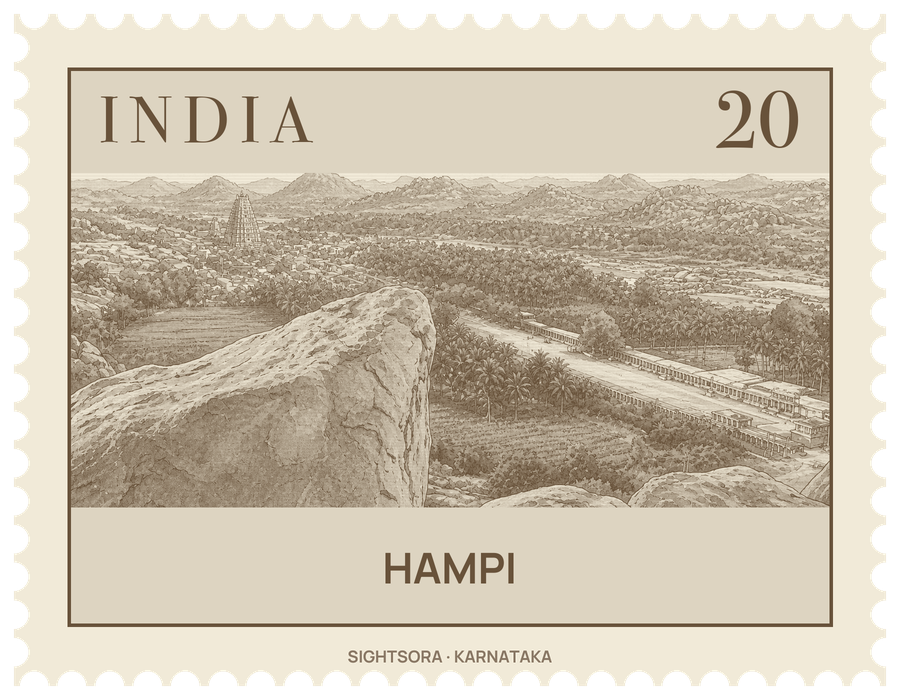
Around 1,600 surviving monuments, mostly Hindu but also Jain and Muslim, cover the site: temples and shrines, pillared halls, royal enclosures, markets, gateways, aqueducts and tanks. Persian and Portuguese visitors described a rich, crowded city of temples, farms and markets; in 1565, after the Battle of Talikota, the armies of an alliance of sultanates captured it, killed the king Aliya Rama Raya and sacked it for six months, and it was left in ruins. UNESCO lists the ruins as a World Heritage Site, and the city of Hosapete lies 13 kilometres away.
The place was holy long before the empire. Its name goes back to Pampa, the old name of the river and a name of the goddess Parvati, who according to local tradition lived as an ascetic on Hemakuta Hill to win Shiva as her husband; Shiva is worshipped here as Pampapati, "husband of Pampa". Regional tradition also identifies the area with Kishkindha, where in the Ramayana Rama and Lakshmana meet Hanuman and Sugriva. Scholars divide the ruins into a sacred centre along the river, with the oldest temples, and an urban core or royal centre to the south, separated by a fertile farming valley.
The Virupaksha Temple is the oldest shrine and still a place of Hindu worship. Parts of it date from the 11th century, and the Vijayanagara rulers enlarged it with a regularly repainted gopuram 50 metres high, a 100-column hall, a community kitchen fed by a channel cut in the rock, and a mandapa whose painted ceiling shows the marriage of Shiva and Parvati and a procession of the scholar Vidyaranya. In front of it runs a ruined stone market 750 metres long with a monolithic Nandi at its eastern end. Hemakuta Hill, between the Virupaksha and Krishna temples, has more than thirty small early temples with pyramidal granite towers, views over the site, and two Ganesha statues carved from the living rock, the larger Kadalekalu Ganesha standing more than 4.5 metres high.
South of the hill, the Krishna temple of 1515 has a gateway carved with the ten avatars of Vishnu and a long market street with a stepped tank. Nearby, a 3-metre Shiva linga stands in water in a small chamber, and a 6.7-metre monolithic Narasimha, the man-lion form of Vishnu, sits in yoga posture. About a kilometre east of Virupaksha, the Achyutaraya temple of 1534 faces north and has a 100-column hall carved with avatars of Vishnu, scenes of daily life and figures in yoga poses. More than 3 kilometres north-east of Virupaksha, the Vitthala temple is an artistically refined complex: its courtyard holds the Garuda shrine built as a stone chariot, a much-photographed symbol of Hampi, and its great mandapa has carved stone beams that produce musical sounds when struck. Nearby stands the King's Balance, used for ceremonies in which a person's weight was given away in gifts.
In the royal centre, the Mahanavami platform rises in three square stages decorated with reliefs of elephants, horses and camels, musicians and dancers, and people throwing water at each other during Holi; south of it, an aqueduct feeds a symmetrical stepped tank of granite excavated in the 1980s. The Hazara Rama temple, the royal family's ceremonial temple from the early 15th century, has outer walls carved in bands with festival processions and inner walls covered with the story of the Ramayana. The so-called Queen's Bath, probably a public bath, has a pillared, vaulted basin, and the Lotus Mahal, a two-storey pavilion, joins a Hindu square plan with lobed arches and domes in Indo-Islamic style. The elephant stables nearby are a row of eleven chambers under alternating fluted and plain domes.
Smaller sites fill the rest of the area. The Kodandarama temple looks over the river at Chakratirtha, where a Vijayanagara-era ghat lines the bank and a rock nearby is carved with 1,008 lingas. The Ganigitti Jain temple of 1385, near Bhima's gate, has plain walls and a stepped pyramidal tower, and a fortified gateway near it was built with three changes of direction to confuse attackers. The Archaeological Survey of India runs a museum at Hampi, near the Pattabhirama temple complex.