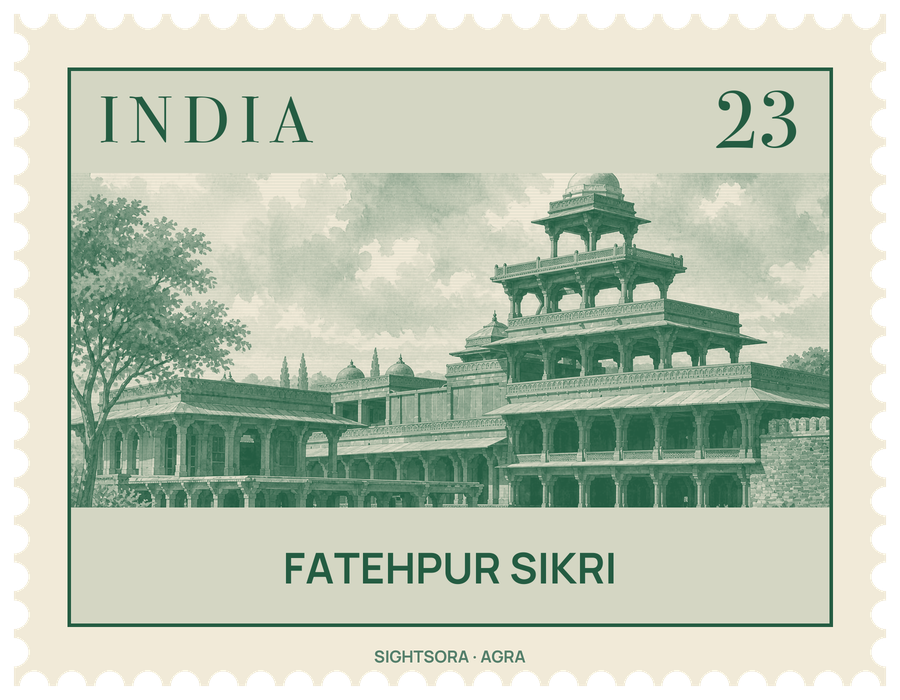
He founded it in 1571 next to the khanqah of the Sufi saint Sheikh Salim Chishti, who had foretold the birth of Akbar's son Jahangir in the village of Sikri in 1569. After Akbar's victorious campaign in Gujarat in 1573 the town took the name Fatehpur Sikri, which means "City of Victory". In 1585 Akbar left for a campaign in Punjab and moved the court away, and by 1610 the city was completely deserted, most often explained by a failing water supply. The palace city was listed as a UNESCO World Heritage Site in 1986.
The site was occupied long before Akbar. Excavations by the Archaeological Survey of India in 1999–2000 uncovered houses, temples and commercial buildings, and at Birchhabili Tila the remains of a Jain shrine dating back to the 6th century and later a Jain temple of local red sandstone, with sculptures including a Jain Sarasvati inscribed with the year 1010. Akbar's predecessor Babur had already laid out a "Garden of Victory" here beside a large lake after defeating Rana Sangha, and gave the place the name Shukri, meaning "thanks".
The city sits on a ridge about 3 kilometres long and 40 metres high, walled on three sides and bordered by a lake on the fourth. Its buildings follow Timurid models, with Gujarati touches and a blend of the Hindu and Muslim domestic architecture of the time, and they have survived well enough to give a clear picture of court life and rank in a Mughal capital. The most famous structure is the Buland Darwaza, the gate raised to honour the Gujarat campaign, which stands 46 metres high over the town. Entry was through a series of gates in the wall, among them the Delhi, Agra, Gwalior and Ajmeri gates.
Inside, the ruler met his subjects in the Diwan-i-Aam, the Hall of Public Audience: a rectangular, many-bayed pavilion looking onto a large open space; Turkic baths stand to its south-west. Akbar built the Ibadat Khana, or House of Worship, in 1575 for the gatherings in which he laid the foundations of his syncretic faith, Din-e-Ilahi. The palace of his chief Rajput wife, Mariam-uz-Zamani, commonly called Jodha Bai, is arranged around a private courtyard and shows Rajput influence, with a Hindu temple and a tulsi math for worship; it was connected inside to Akbar's own sleeping quarters.
Other buildings fill out the picture of the court. The Naubat Khana, or drum house, where musicians announced the emperor's arrival, stands in front of the Hathi Pol, the Elephant Gate on the south side. The Pachisi Court is a square laid out as a giant board for the forerunner of Ludo, with people as the pieces. Birbal's House, built for Akbar's favourite minister, is known for its sloping stone sunshades, or chajjas, and the brackets holding them up. The Hiran Minar is a round tower studded with stone projections shaped like elephant tusks; tradition says it marked the grave of Akbar's favourite elephant, though it more likely served as the starting point for a line of mileposts. The complex also held a mint, a records office, a treasury, royal workshops, stables and a caravanserai.
Getting there
Fatehpur Sikri is less than 40 kilometres from Agra by road, and UPSRTC runs regular buses between them; tourist buses and taxis also make the trip. Fatehpur Sikri railway station is about 1 kilometre from the town centre, and the nearest airport is Agra Airport, also called Kheria Airport, around 40 kilometres away.