Most of them are dedicated to Shiva, and their great relief panels tell Hindu legends, above all the colossal three-faced Sadashiva, or Trimurti, in the main cave. Scholars have dated the caves anywhere between the 5th and 9th centuries, though many now place their completion around the middle of the 6th century and credit them to the Kalachuri king Krishnaraja. The site was listed as a UNESCO World Heritage Site in 1987.
The island has two wooded hills separated by a ravine. Five Hindu caves are cut into the western hill, known as Canon Hill after the Portuguese guns it once held; on the eastern Stupa Hill lie two Buddhist caves, water tanks and the mound of a brick stupa from about the 2nd century BCE, since Buddhists seem to have been the first to settle here. The Portuguese, who took the island in 1534, named it after a huge stone elephant near their landing place; that statue now stands in the Jijamata Udyaan in Mumbai. Much of the sculpture was badly defaced in the centuries before British rule, and scholars disagree over how much of the damage dates from the Sultanate period and how much from Portuguese soldiers. The main cave was restored in the 1970s.
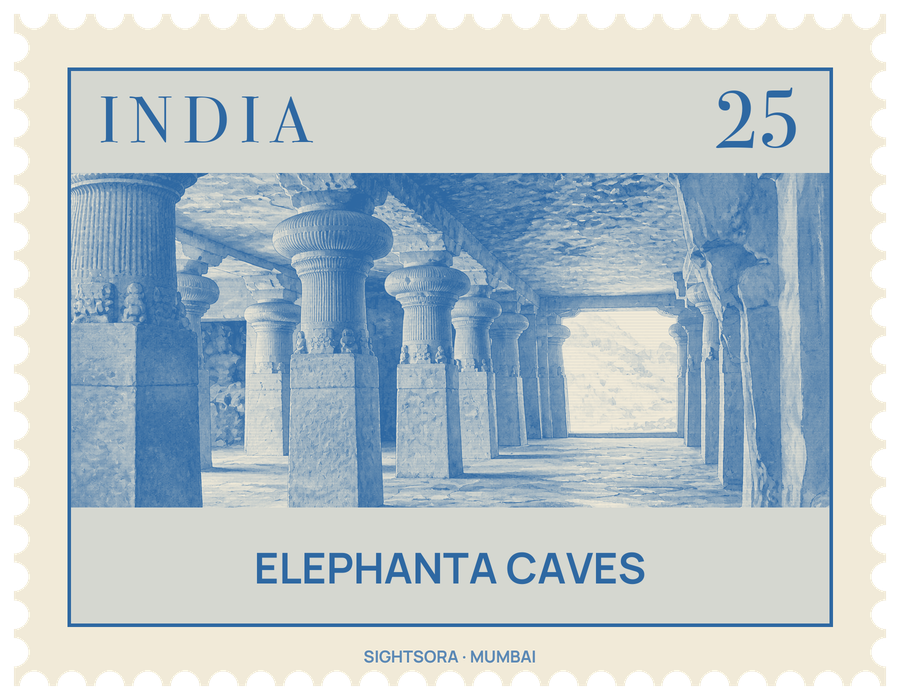
Cave 1, the Great Cave, is a square pillared hall about 39 metres across, entered through a modest north doorway that gives no hint of the space inside. Two temples are fused within it. One is a free-standing square shrine aligned east–west, with a door on each side guarded by a pair of towering dvarapalas and a linga raised on a platform at its centre, visible from almost anywhere in the cave. The other runs north–south and leads the eye to the Sadashiva on the south wall, whose three faces show Shiva as a calm, meditative central figure, a fierce moustached Aghora on the left and a gentler feminine aspect holding a lotus bud on the right.
Huge panels, each more than 5 metres high, line the walls around it. Beside the Trimurti, Ardhanarishvara shows Shiva and Parvati fused into one half-male, half-female body, and Gangadhara shows Shiva catching the descending Ganges in his hair while a small three-bodied goddess stands for the three rivers. Elsewhere Shiva appears as a ferocious Bhairava slaying the demon Andhaka, as the groom at his wedding to Parvati with Brahma as priest, as the meditating Yogishvara on a lotus, as the eight-armed dancing Nataraja, seated with Parvati on Mount Kailash, and shaken there by the demon king Ravana. A side shrine to the east has a courtyard and a panel of the mother goddesses flanked by Ganesha and Kartikeya.
South-east of the Great Cave, Caves 2 to 5 are smaller and more ruined: Cave 2 is unfinished, Cave 3 has a pillared portico with a damaged shrine behind it, Cave 4 keeps a lingam in its rear shrine, and Cave 5 is unfinished with no carving left. Across the ravine, Cave 6, called Sitabai's temple, is a plain hall whose shrine door is carved with pilasters and lion figures; the Portuguese used it as a church. Beyond the small abandoned Cave 7 are a dry pond, Buddhist cisterns and the stupa mound. The Archaeological Survey of India looks after the site and runs a small museum on the island.
Getting there
Ferries run to the island from the Gateway of India in Mumbai, about 11 kilometres away across the harbour. Boats land at the quays on the island, and from the pier a footpath or a small tourist toy train leads towards the caves; the Great Cave is about a kilometre up the hillside, with a final climb of 120 steep steps.