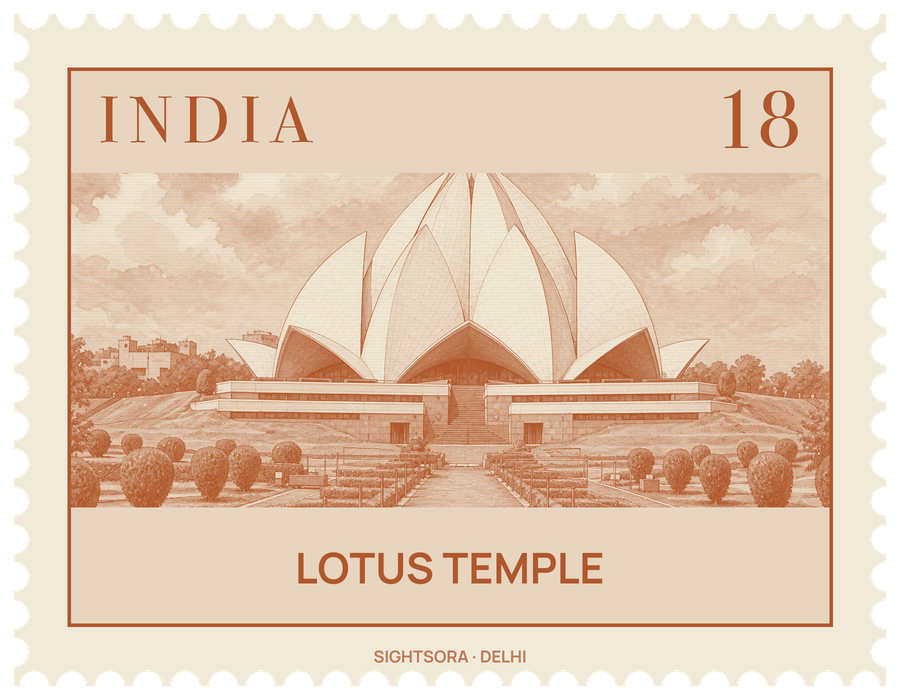
The architect Fariborz Sahba designed it, and after its dedication on 24 December 1986 the doors opened to all on 1 January 1987. Like every Baháʼí House of Worship it welcomes people of any religion, and for Indian Baháʼís it has also become their main sacred site.
The project goes back a long way. A national Baháʼí convention in Bombay voted in 1920 to start raising funds, the land at Bahapur, whose name translates as "Abode of Bahá", was bought in 1954, and Sahba was chosen from 45 architects in a worldwide competition in 1976. Before settling on a form he travelled across India and Sri Lanka visiting temples and sacred places of several faiths; he has said the lotus was first proposed to him by an Indian Baháʼí, and that the lotus carvings of the Ajanta and Ellora Caves led him to it, a flower he saw as sacred in Indian tradition and a symbol of purity. Work on site ran from 1980 to 1986.
All Baháʼí temples must be circular and nine-sided, and here the petals are grouped in threes to make the nine sides. The outermost ring opens outward to shelter nine doorways, the next ring curves inward to roof the walkway around the hall, and the innermost petals stay almost closed around the central hall, parting only at their tips, where a glass and steel skylight lets in daylight. The temple rises 40.8 metres above the entrance level, and inside, a ribbed dome of thin concrete shells climbs 28 metres over the hall floor. Because the design allowed no plaster or paint, the white concrete of the inner surfaces shows patterns set out along the geometry of each shell.
The outer shells are faced with white Pentelic marble from the quarries of Mount Pentelicus in Greece, shaped in Italy before shipping, while the outer podium's walkways and stairs are of red sandstone. Nine pools ring the building like the leaves of the flower, so that the lotus seems to float, with bridges, stairs and curved balustrades running between them. The pools also play a part in cooling: air drawn in over the water enters through vents at basement level and leaves through the crown of the dome, so the building works like a chimney.
Services in the prayer hall are kept simple. Readings and chanting come from the scriptures of the major world religions and may be in any language, there are no sermons or rituals and no Baháʼí clergy, and choirs may sing but no instruments are played; at certain times visitors may sit in silent meditation and prayer. Beside the temple, a visitor centre known as the Information Centre has been open since 2003, with exhibition galleries and an auditorium seating 500.
Getting there
The temple lies on the southern outskirts of New Delhi, east of Nehru Place and close to the Kalkaji Temple. Kalkaji Mandir is the closest metro station.