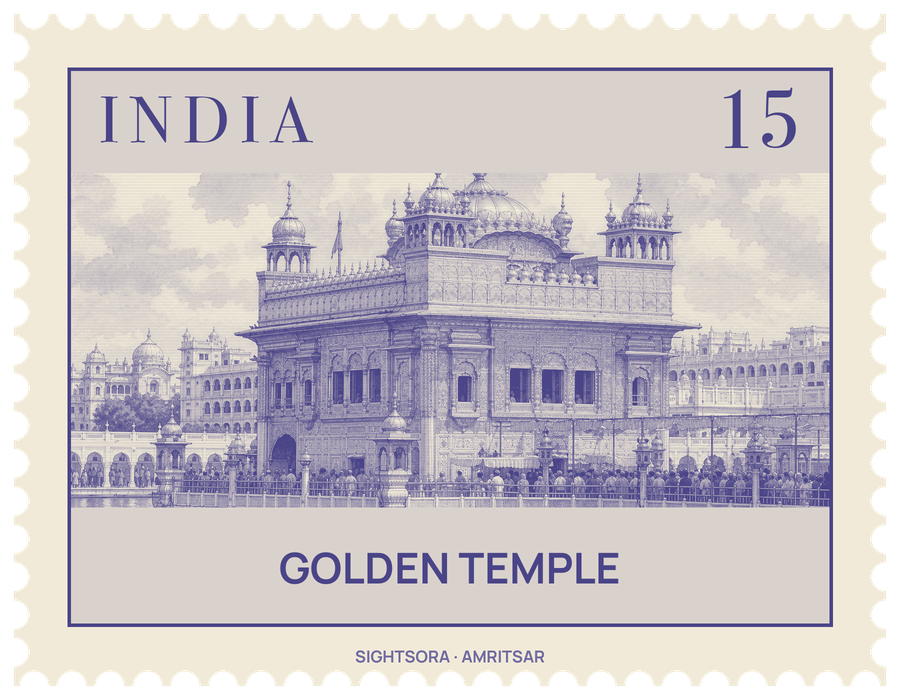
Its name joins Hari, God, and mandir, house, with the respectful Sikh title Sahib. Around the pool runs a marble walkway, the parikrama, which pilgrims walk clockwise, and the whole complex is enclosed by a two-storey courtyard with four entrances, meant to show that people of every caste, faith and background are welcome.
The site grew from a pool beside a jujube tree. The fourth Guru, Ram Das, completed the pool and founded the town of Ramdaspur, which grew into Amritsar, and his successor Guru Arjan built the first brick shrine, finished in 1589. He deliberately set it lower than the surrounding ground, so that worshippers walk down to it as a sign of humility, and in 1604 he installed the Adi Granth, the Sikh scripture, inside. Mughal and Afghan armies attacked and destroyed the temple several times in the 18th century, and the Sikhs rebuilt it each time. After taking Amritsar in 1802, Maharaja Ranjit Singh paid for a renovation in marble and copper completed in 1809, and in 1830 he gave the gold that covers the sanctum, from which the temple takes its English name.
The sanctum is a square of 12.25 metres on a marble platform, crowned by a gold-leaf dome with a pinnacle and smaller gilded cupolas at the corners. The Guru Granth Sahib sits on the lower floor, a few steps above the causeway, and for a few hours each day it is carried in a palki to its resting room in the Akal Takht and back with ceremony. The copper doors are covered in gold leaf worked with birds and flowers, verses of scripture run in gold letters over the arches, and the upper floor holds the Shish Mahal, a room of small mirror pieces set into walls and ceilings. Marble panels on the outer walls are inlaid with semi-precious stones such as lapis lazuli and onyx in the pietra dura manner, and unlike Mughal inlay they include animal and human figures. The causeway begins at the Darshani Deori, a two-storey gateway whose front is covered in silverwork and whose doors carry ivory inlay of deer, tigers, lions and birds.
Pilgrims bathe in the pool, 5.1 metres deep, believing its water purifies, and some take bottles of it home for sick relatives; behind the sanctum, the Har ki Pauri steps let worshippers sip from it. Volunteers drain and clean the pool from time to time as kar seva, or community service. Three jujube trees survive in the courtyard: the Ber Baba Buddha, where tradition says Baba Buddha sat to oversee the building work; the Laachi Ber, where Guru Arjan rested; and across the pool the Dukh Bhanjani Ber, the "suffering remover", with a small gurdwara beneath it and the Ath Sath Tirath, a spot believed to equal 68 places of pilgrimage.
Facing the causeway stands the Akal Takht, "throne of the Timeless", founded by Guru Hargobind as the chief of the five Takhts, the seats of Sikh religious authority, from which edicts on Sikh matters are issued. It was destroyed in 1984 during Operation Blue Star, when the Indian Army, on the orders of Prime Minister Indira Gandhi, attacked militants led by Jarnail Singh Bhindranwale who had occupied the complex; soldiers, militants and civilians died, and the Sikhs rebuilt the Akal Takht in 1999. Above the walkway rise the two red sandstone towers of the Ramgarhia Bunga, 18th-century watchtowers named after Jassa Singh Ramgarhia. The northern entrance, the ghanta ghar deori, replaced a Gothic clock tower the British put up and has a Sikh history museum on its upper floor, with paintings of Gurus and martyrs and objects such as swords.
On the east side, outside the courtyard entrance near the Dukh Bhanjani Ber, the Guru Ram Das Langar is a free community kitchen and dining hall. Volunteers serve vegetarian meals to anyone who wants one, whatever their faith, gender or means, and everyone eats sitting together on the floor in rows. Near the langar, the Teja Singh Samundri Hall houses the Shiromani Gurdwara Parbandhak Committee, the elected body that has run the temple since the reform campaigns that followed the Jallianwala Bagh massacre of 1919 next door. Besides daily worship, the temple marks Baisakhi and Diwali as well as the gurpurabs, the anniversaries of Guru Nanak and Guru Ram Das.