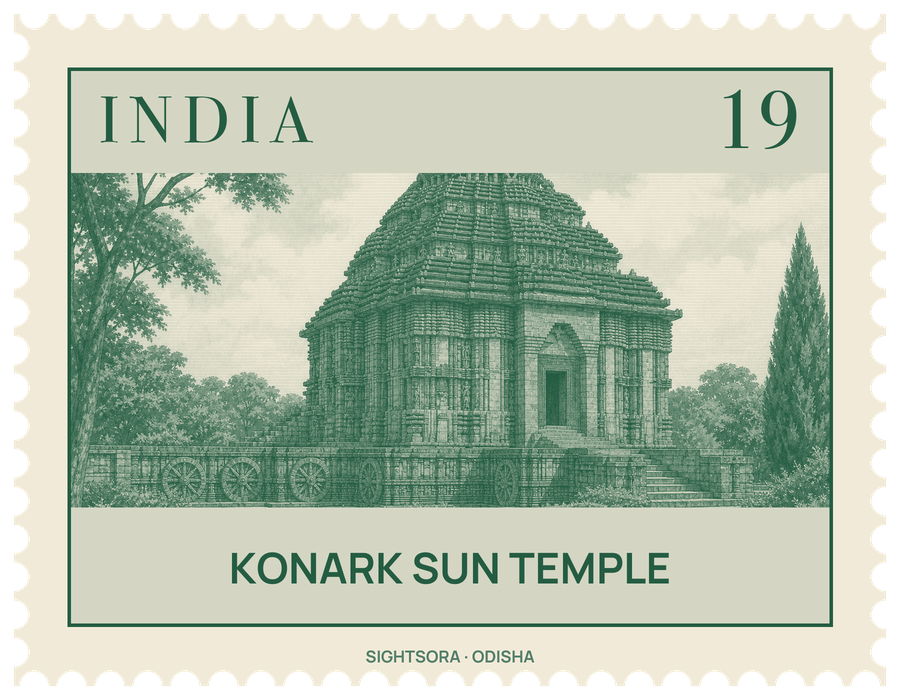
It dates from about 1250 CE, the reign of Narasingha Deva I, an Eastern Ganga king. The great tower over the sanctum has long since fallen, and what visitors see today is chiefly the jagamohana, the assembly hall that stood before it, still one of the high points of the Kalinga style of temple building. UNESCO declared it a World Heritage Site in 1984.
The symbolism runs through the whole design. In Hindu iconography Surya rises in the east and rides across the sky behind seven horses, named after the seven metres of Sanskrit verse, and the twelve pairs of wheels stand for the months of the Hindu calendar. The temple faces east so that the first light of the sunrise falls on its main entrance. European sailors knew it as the "Black Pagoda" as early as 1676; together with the "White Pagoda", the Jagannath Temple at Puri, it was a landmark for ships in the bay.
The surviving hall rises in three tiers that step back as they climb, and on its terraces stand stone figures of male and female musicians playing the vina and other instruments. To the east, the Nata mandira, or dance hall, sits on a high, densely carved platform, and the ruins of a dining hall, kitchen, wells and smaller shrines, among them the Mayadevi temple uncovered in 1909, are scattered around the main building. The builders worked in three kinds of stone, chlorite for door frames and some sculpture, laterite for the platform's core and khondalite for the rest, all brought from distant sources.
Reliefs cover the temple from base to crown. Along the bottom moulding run elephants, marching soldiers, hunters, a caravan of animals, travellers cooking by the road and festive processions. Higher up, the walls show everyday life in close detail: a girl wringing out wet hair or looking into a mirror, another chasing off a monkey that is trying to snatch something, a teacher among pupils, a mother blessing her son, an old woman with a stick and a bowl. One panel shows the king taking counsel from his guru, carved far smaller than the teacher, with his sword laid on the ground. Among these are the temple's mithuna carvings of couples in courtship and intimacy, set alongside images of Durga, Vishnu, Shiva and Vedic gods such as Indra and Agni, and life-size lions subduing elephants once guarded the gateways.
The temple fell into ruin between the late 16th and 18th centuries and was abandoned to the forest. In the late 18th century its Aruna stambha, a pillar of a single piece of chlorite dedicated to the sun god's charioteer, was carried off to Puri, where it stands at the Lion's Gate of the Jagannath temple. Restoration began under British rule, when in 1903 the hall was filled with sand to stop it collapsing. Many fallen sculptures can be seen at the Konark Archaeological Museum, run by the Archaeological Survey of India, and the temple appears on the back of India's 10-rupee note.
Getting there
Konark lies about 35 kilometres north-east of Puri and 65 kilometres south-east of Bhubaneswar. Bhubaneswar's Biju Patnaik Airport is the closest airport, and both Bhubaneswar and Puri are major railway hubs.