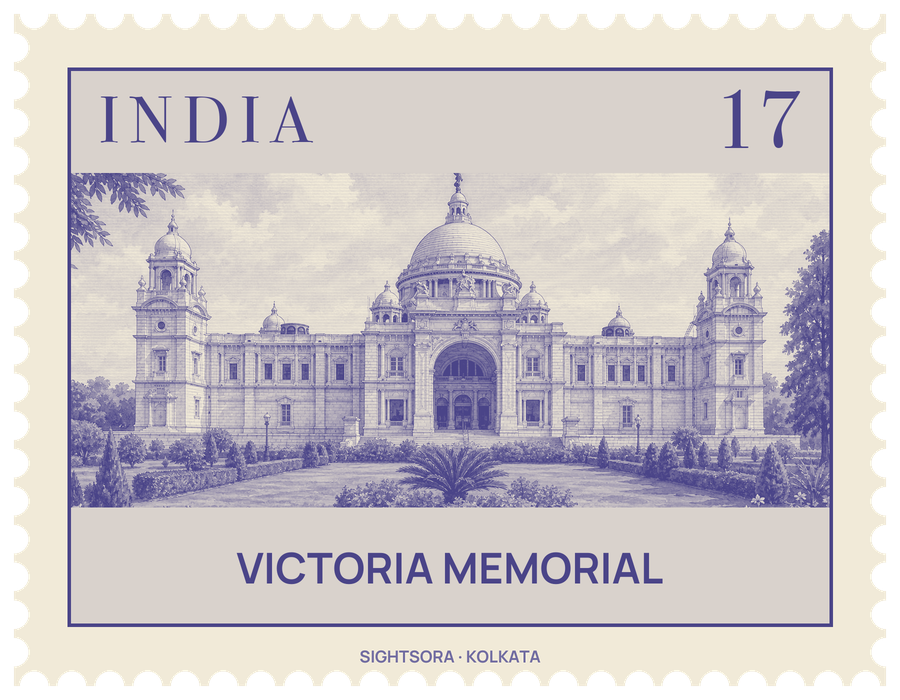
Its entrance is on Queen's Way. Today it is a museum under India's Ministry of Culture, and the institution sees its role as the city's leading art gallery, museum and research library for art history, collecting objects, relics and documents mostly from Indian history of the eighteenth to twentieth centuries.
The idea belonged to the Viceroy, Lord Curzon, who, once the queen had died on 22 January 1901, called for a great marble hall that would be first a monument to the queen and second a national gallery for the Indian Empire. Its cost was met entirely from voluntary subscriptions by officials, princes and the public. George, Prince of Wales, laid the foundation stone on 4 January 1906, Martin & Co. of Calcutta began the superstructure in 1910, and in 1911 the capital moved from Calcutta to New Delhi before the building was finished. The future Edward VIII opened it to the public in December 1921.
The architect, William Emerson, worked in the Indo-Saracenic style, blending British and Mughal forms with Venetian, Egyptian and Deccani touches. The building measures 103 by 69 metres and rises to 56 metres, and with its central dome, four smaller domes, octagonal chattris, high portals and corner towers it deliberately recalls the Taj Mahal; Curzon set the central chamber at 20 metres across. On top of the dome turns a 4.9-metre bronze Angel of Victory by Vincent Jerome Esch, and allegorical figures of Art, Architecture, Justice and Charity surround the dome, with Motherhood, Prudence and Learning above the North Porch.
Inside, twelve canvas lunettes by Frank Owen Salisbury around the rotunda show moments from Victoria's life, and a statue of the queen in coronation robes by Thomas Brock stands in the central hall. The museum has 25 galleries, among them the royal gallery, the portrait gallery, the sculpture gallery, the arms and armoury gallery and the national leaders' gallery. It holds a large body of work by Thomas Daniell and his nephew William Daniell, and rare books including illustrated Shakespeare, the Arabian Nights and the Rubaiyat of Omar Khayyam. The Victoria Gallery hangs copies of paintings of the queen's coronation, wedding and jubilees, with her childhood rosewood pianoforte and her writing desk from Windsor Castle in the middle of the room, and a painting by Vasily Vereshchagin of the Prince of Wales entering Jaipur in 1876.
The Kolkata gallery, opened in 1992, traces the visual history and growth of the city and includes a life-size diorama recreating Chitpur road as it looked in the late 1800s. Outside, the gardens designed by Lord Redesdale and David Prain are dotted with statues: George Frampton's bronze of an enthroned Victoria on Esch's north bridge, figures of Hastings, Cornwallis, Clive, Wellesley and Dalhousie around the building, and to the south the Edward VII memorial arch, with an equestrian statue of the king by Bertram Mackennal and a marble Curzon by F. W. Pomeroy.