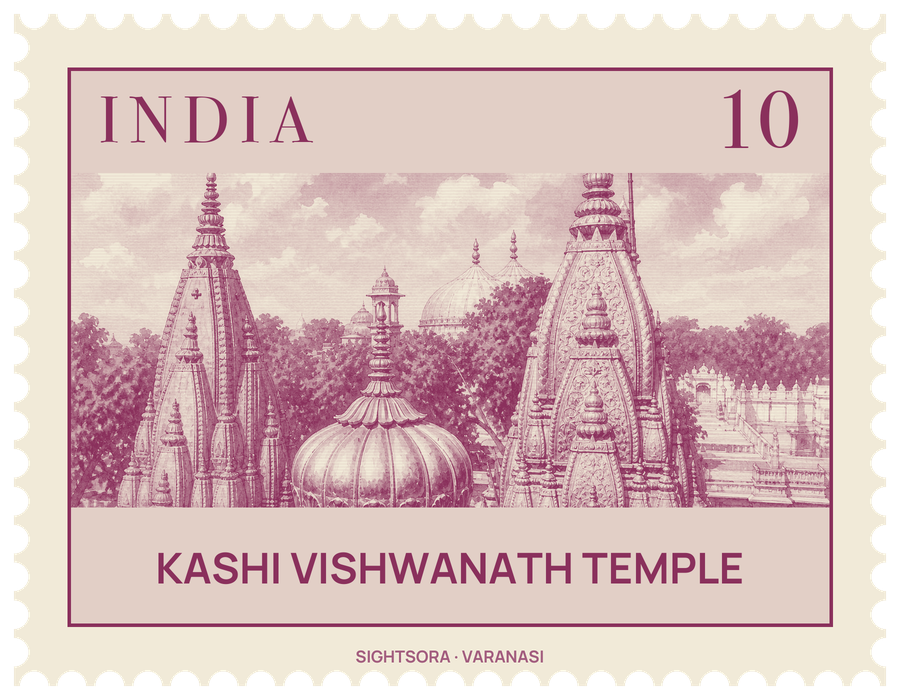
It is one of the twelve Jyotirlinga shrines, and Hindu scriptures treat Vishweshwara as king over the other deities of Varanasi and over everyone who lives in the city. The gold plating on its spire has earned it the popular name of the Golden Temple. Hindus hold that a visit here combined with a bath in the river is one of the paths towards moksha, or liberation.
The temple's meaning rests on a legend. When Brahma and Vishnu quarrelled over which of them was supreme, Shiva appeared before them as an endless pillar of light. Vishnu became a boar and burrowed downwards to find its base, while Brahma took the shape of a swan and flew upwards to find its top; neither reached the end, but Brahma lied that he had, and Shiva punished him by cutting off his fifth head. Varanasi is believed to be the first place where such a jyotirlinga appeared.
The shrine has been destroyed and rebuilt many times. The original Adi Vishveshwar Temple was razed by the Ghurids in 1194, and a later temple was pulled down under Sikandar Lodi in 1490. Raja Man Singh and Raja Todar Mal rebuilt it in the reign of Akbar, but in 1669 the Mughal emperor Aurangzeb had it demolished and the Gyanvapi Mosque was raised on the site; parts of the older temple survive in the mosque's foundation, columns and rear section. Some historians connect that demolition with armed local resistance to Mughal forces rather than with religion alone. The present temple was built beside the mosque in 1780 by Ahilyabai Holkar, the Maratha ruler of Indore.
Rulers from across the subcontinent left their mark on the building. In 1835 the Sikh ruler Maharaja Ranjit Singh, prompted by his wife Maharani Datar Kaur, gave 1 tonne of gold to cover the dome, and silver came in 1841 from Raghuji Bhonsle III of Nagpur. In 1828 Baiza Bai, widow of Daulat Rao Scindhia of Gwalior, added a low colonnade of more than 40 pillars in the Gyan Vapi precinct. In February 2022 the sanctum itself was gilded with 60 kg of gold given by an anonymous donor from South India.
The complex is a cluster of small shrines around the main temple, which is laid out as a quadrangle; among the deities with small temples of their own are Ganesha, Vishnu, Kartikeya, Kala Bhairava, Shani, Parvati and Avimukteshwara. A congregation hall, the Sabha Griha, leads into the sanctum, where the linga, 60 centimetres tall and 90 centimetres around, sits on a silver platform. The temple rises in three parts: a spire 15.5 metres high, a gold dome, and a gold spire above the sanctum topped by a flag and a trident. North of the main temple is the Jnana Vapi, the 'well of wisdom', in which, by tradition, the jyotirlinga was hidden to protect it during the Mughal invasion.
Since 1983 a trust board created by the Uttar Pradesh government has managed the temple. The Kashi Vishwanath Dham corridor, inaugurated by Prime Minister Narendra Modi on 13 December 2021, links the temple with the river at Manikarnika Ghat and gives pilgrims more space; during the work more than 40 old temples were uncovered and rebuilt, among them the Gangeshwar Mahadev and Manokameshwar Mahadev temples. On Rangbhari Ekadashi, twelve days after Maha Shivaratri, dozens of damroo drums sound through the complex to welcome Shiva back to Kashi with his consort Parvati.