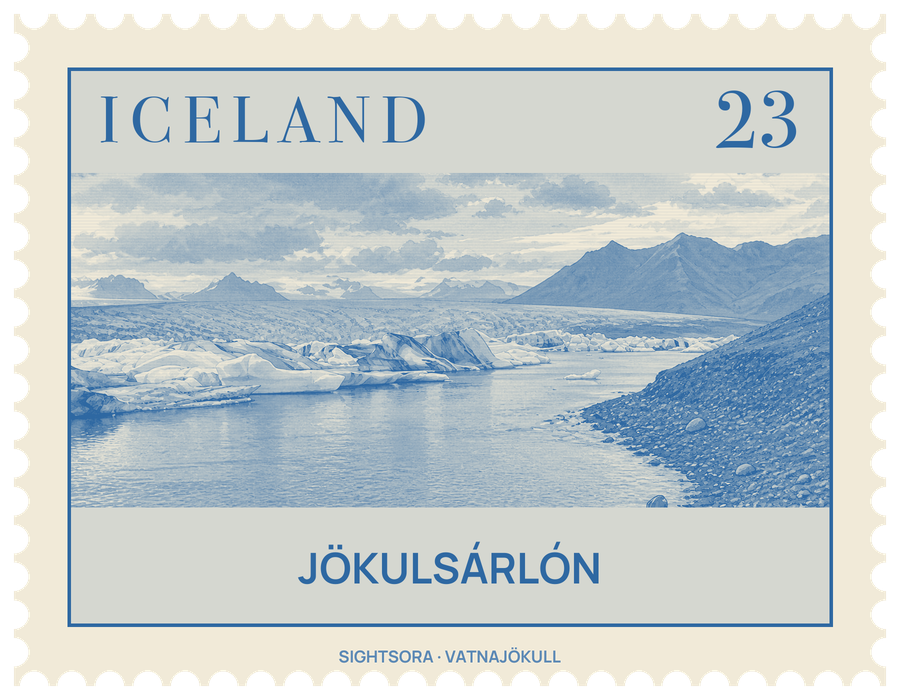
Blocks of ice about 30 m high break off the glacier front and float across the water, and from the shore the white dome of Vatnajökull is in view behind them. The ice shows two colours, a milky white and a bright blue, depending on how much air is trapped inside it and how light passes through the crystals, and some bergs are streaked with dark volcanic ash from old eruptions.
The lagoon is young. When the first settlers reached Iceland around AD 870 the glacier ended about 20 km further north, and during the Little Ice Age it grew until by about 1890 it stood roughly 1 km from the coast. As temperatures rose between 1920 and 1965 the ice pulled back fast, and a lake formed in its place around 1934–35. It has kept growing as the glacier retreats: from about 8 km² in 1975 it has spread to some 25 km², and it is more than 200 m deep where the glacier snout once lay. Moraines left by the ice line both sides.
The icebergs drift slowly towards the shallow outlet, pushed by wind and tide, often grounding on the bottom until they have melted small enough to float out to sea. Many end up stranded on the black sand beach beside the river mouth, Eystri-Fellsfjara, which people call the diamond beach because of the chunks of ice scattered across it. Seals swim in the lagoon or haul out on the ice, and gather at the mouth in winter to hunt fish carried in by the tide; Arctic terns nest nearby, and Arctic skuas nest on the shores of the lake.
Beyond the lagoon spreads Breiðamerkursandur, an outwash plain about 25 km wide built by the glacier. In 2017 the Icelandic State acquired Fell, the farm on whose land the lagoon lies, and the ground around the lagoon became part of Vatnajökull National Park. Boat trips on the lagoon began in 1985, the year the Bond film A View to a Kill was shot here, and boat and kayak tours are run by several companies. Film crews have come back since, for Batman Begins, Die Another Day and Lara Croft: Tomb Raider among others, and hiking trails lead around the area.
Getting there
Jökulsárlón lies on the ring road, Route 1, which crosses the lagoon outlet by a bridge, 75 km west of Höfn and 60 km east of Skaftafell; there is parking beside the lagoon.