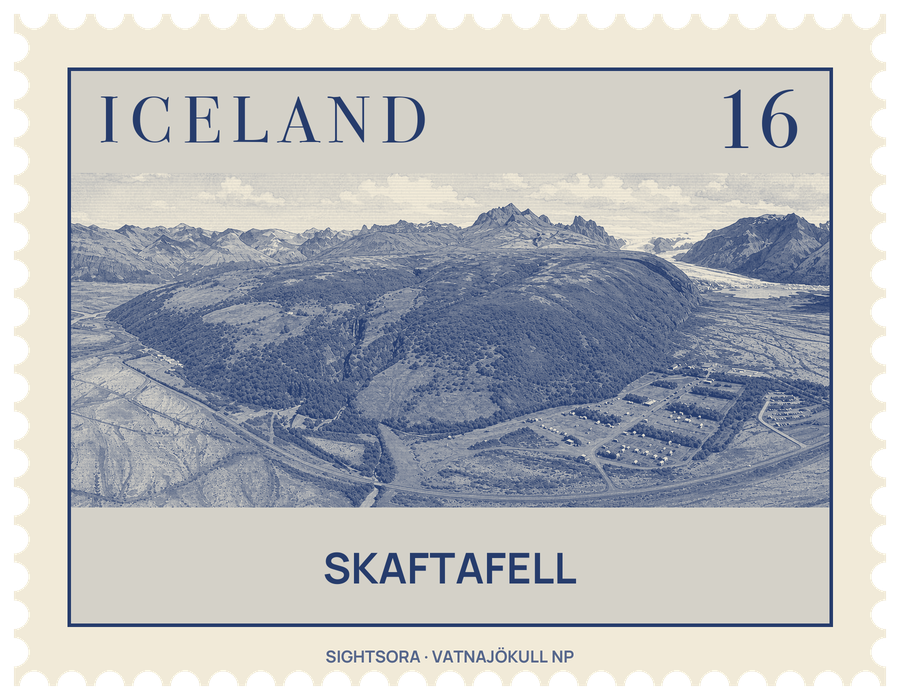
It began as a large farm, was made a national park on 15 September 1967 and on 7 June 2008 became part of the much larger Vatnajökull National Park. Its scenery of glacier tongues flanked by jagged peaks, with the ice-capped summit of Hvannadalshnjúkur rising above them, has been shaped by fire and water: eruptions of Öræfajökull, and the glaciers Skeiðarárjökull and Skaftafellsjökull together with the rivers that drain them.
Within the area lie the valley of Morsárdalur, the mountain Kristínartindar and Skaftafellsjökull, a tongue of the Vatnajökull ice cap. To the south spreads Skeiðarársandur, a broad outwash plain of sand laid down by jökulhlaups, the floods released when volcanoes erupt beneath the ice; the last large one came in 1996. The Skeiðará was the last river that kept Road No. 1 from circling the whole country, until it was bridged in 1974. Among the sights is Svartifoss, which drops about 20 metres in front of black basalt columns.
Sheltered by Öræfajökull, Skaftafell enjoys a milder climate than much of the south coast, with sunny summer days that are unusual in the region. Birch and the odd rowan clothe the lower slopes, and in the native wood of Bæjarstaðarskógur the birches grow taller than most others in Iceland. Since sheep stopped grazing here, plants such as garden angelica, sea pea and arctic river beauty have spread across Morsárdalur and over the glacial debris in front of Skaftafellsjökull. Redwings, redpolls and wrens are common in the woods, ptarmigan and golden plover appear higher up, and the Arctic fox lives here too.
Farming at Skaftafell goes back almost to the settlement of Iceland, and district assemblies were once held on its land. The Öræfajökull eruption of 1362 destroyed the whole community and left the district with its name, Öræfi, "the wasteland". The farm was later rebuilt, but floods set off by Grímsvötn eruptions buried its hayfields under ash and sand. Ruins of the old farmstead are still visible at Gömlutún below the slopes; in the early 19th century the farm moved up the hillside and split into three households, one of which, Sel, was abandoned in 1946 and which the National Museum later restored and opened to visitors. Traditional farming here ended in 1988.
The Skaftafell Visitor Centre serves the southern part of Vatnajökull National Park, with information on its trails, nature and history and display boards on how people and nature have shaped each other here. Many hiking trails cross the area, there is a large campground, and glaciers nearby are used for guided glacier tours.