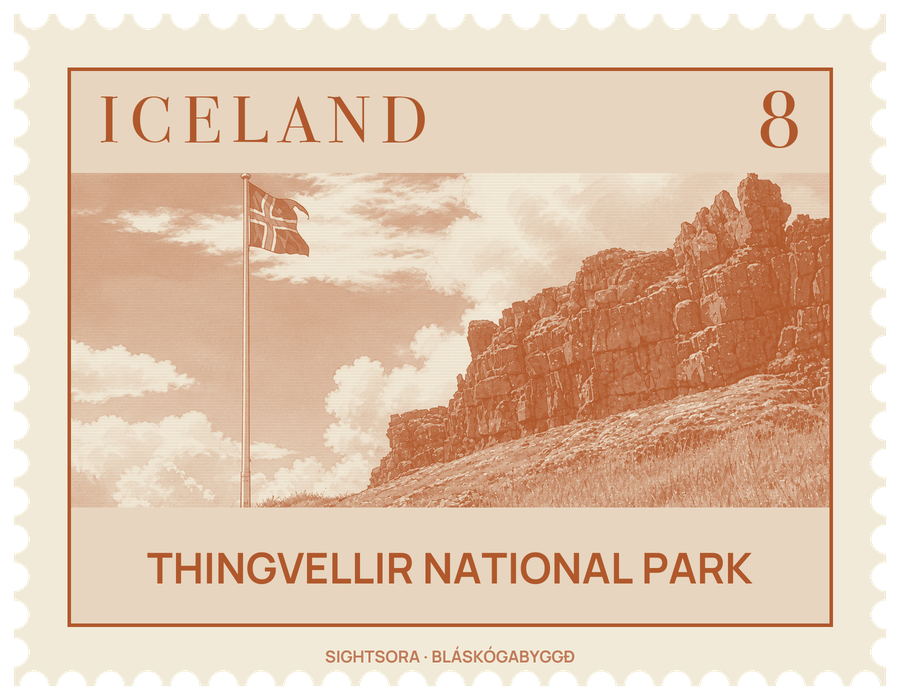
The site lies in a rift valley about 40 km northeast of Reykjavík, on the crest of the Mid-Atlantic Ridge where the North American and Eurasian plates meet, with the lake Þingvallavatn to the south. It became a national park in 1930, the thousandth anniversary of the Althing, under a law that declared it a protected shrine for all Icelanders, never to be sold or mortgaged; the park was later enlarged to protect the natural features around it and was inscribed as a UNESCO World Heritage Site in 2004.
The place was chosen partly because it was within reach of the most populous parts of the north, west and south, although a chieftain coming from the far east of the country might travel for 17 days. For two weeks each year people came from every part of Iceland, sometimes thousands of them, and lived in temporary booths (búðir) with walls of turf and rock under roofs of homespun cloth. Alongside the lawmaking, merchants, sword-sharpeners and tanners did business, entertainers performed, ale-makers brewed for the crowds, and news, games and feasts turned the assembly into a meeting place for the whole nation.
The heart of the assembly was the Lögberg, or Law Rock, a natural platform where the Lawspeaker, chosen for a three-year term, recited the law, and where the assembly opened and closed, rulings were announced and the calendar was confirmed. The Law Council, which served as both parliament and supreme court, met on the east bank of the Öxará until the river changed course around 1500, then on an islet in the river, and from 1594 at the foot of the Law Rock. In the 19th century Þingvellir grew into a symbol of Icelandic nationhood.
The drift between the two plates is plain to see in the cracks and faults that cut across the valley. The largest, Almannagjá, is a true canyon, and the river Öxará forms a waterfall there called Öxarárfoss. Some fissures are filled with clear water: Nikulásargjá was bridged in 1907 when King Frederik VIII of Denmark came to visit, and the coins that visitors have tossed in from the bridge ever since earned it the name Peningagjá, the "coin fissure". On the northern shore of the lake, the Silfra fissure draws diving and snorkelling tours.
Þingvellir is one of the three main stops on the Golden Circle, together with the Gullfoss waterfall and the geysers of Haukadalur. A visitor centre explains the history and nature of the park, an information centre stands near the camping grounds, and hiking trails include the Execution Trail and the nearby Leggjabrjótur. The setting has long attracted painters such as Johannes Sveinsson Kjarval and Ásgrímur Jónsson, and more than 150 of Ásgrímur Jónsson's paintings of Þingvellir belong to the National Gallery of Iceland.