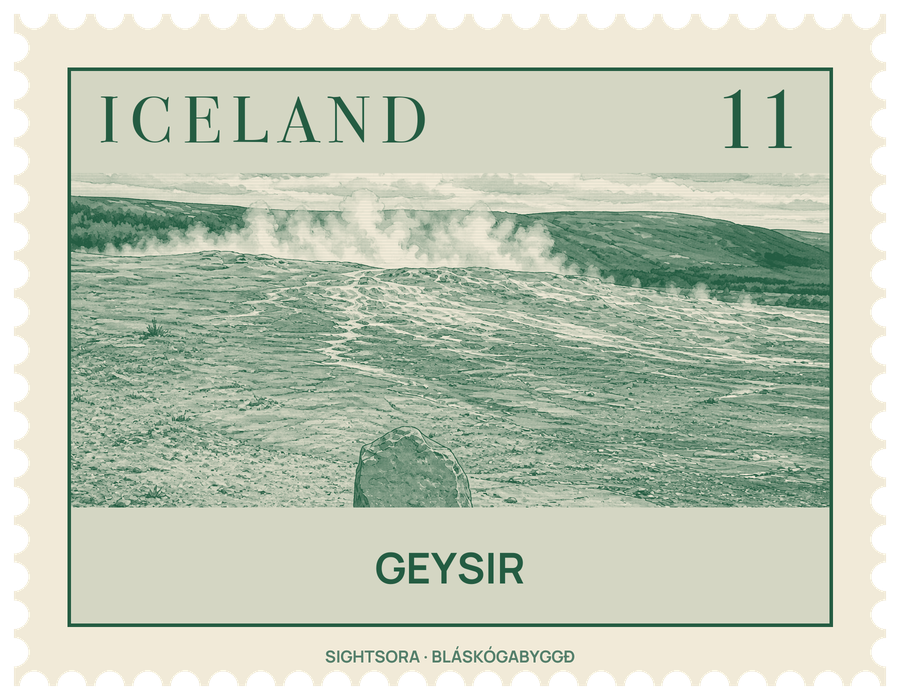
It sits on the slopes of the Laugarfjall lava dome in a geothermal field that also holds Strokkur, about 50 metres to the south, and some thirty far smaller geysers and hot pools, among them Litli Geysir. Together with Þingvellir and the Gullfoss waterfall, the field is one of the stops on the Golden Circle.
Sinter deposits around the vent date the geyser's formation to about 1150 CE, and the name Geysir first appears in writing in 1647. Its activity has always risen and fallen with earthquakes. In 1846 the German chemist Robert Bunsen measured eruptions of 45 to 54 metres, and his research did much to explain how geysers work. Before 1896 Geysir was almost dormant, until an earthquake that year set off eruptions several times a day, up to 70 to 80 metres high; by 1916 they had all but stopped. A channel cut through its silica rim in 1935 brought it back for a time, and earthquakes in 2000 pushed it to 122 metres for two days. After that its large eruptions grew so rare that one in 2016 was treated as news.
Strokkur erupts much more often than Geysir, sending water up to 35 metres into the air every few minutes, and unlike Geysir it gives little warning before it goes off; photos and videos of Strokkur are often mislabelled as Geysir. Geysir itself is a hot water pool geyser, with a funnel-shaped vent 0.4 to 1.0 metre across that narrows at a depth of about 23 metres. Water in the upper part of its conduit is 85 to 95 °C and reaches about 120 °C further down.
Local farmers owned the land until 1894, when it was sold to James Craig, an Ulster whiskey distiller, who fenced the geysers off and charged visitors to see them; a year later he gave the site to a friend, E. Craig, who did away with the charge. In 1935 the film director Sigurður Jónasson bought it and donated it to the Icelandic people for all time, and on 17 June 2020 Iceland's environment ministry placed Geysir under official protection.