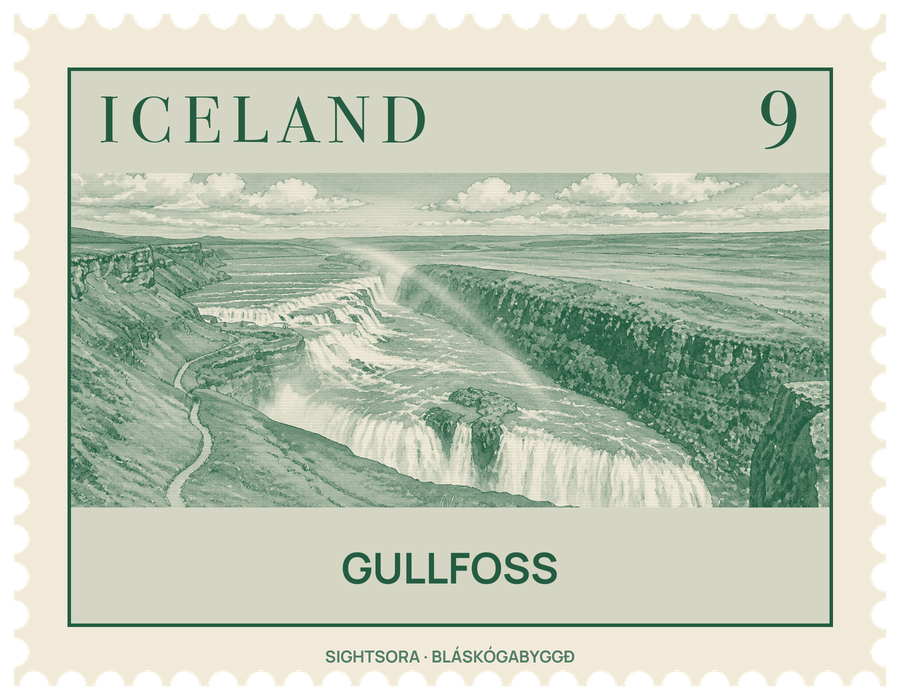
The falls sit between the municipalities of Bláskógabyggð and Hrunamannahreppur, and along with Þingvellir and the geyser field of Haukadalur, home of Geysir, they form the Golden Circle, the day excursion from Reykjavík that brings most visitors here.
About a kilometre upstream, the southward-flowing river bends hard to the west and spills over a broad, curving staircase of three steps. It then falls 11 metres and, a moment later, another 21 metres into a crevice 32 metres deep. The crevice is roughly 20 metres wide and 2.5 kilometres long and runs at right angles to the river, so from the edge the water seems to vanish into the ground. In summer an average of 141 cubic metres of water pours over every second, against about 80 in winter, and the biggest flood ever measured reached 2,000 cubic metres per second.
For much of the 20th century there were plans to harness Gullfoss for electricity, and its owners, Tómas Tómasson and Halldór Halldórsson, leased it indirectly to foreign investors, whose schemes failed, partly through lack of money. Popular memory credits Sigríður Tómasdóttir, daughter of one of the owners, with saving the falls: she pressed for legal protection against foreign control and is said to have threatened to throw herself into the water. A stone memorial carved with her profile stands above the falls. The Icelandic government later bought Gullfoss, and in 1979 it became a permanent conservation site.