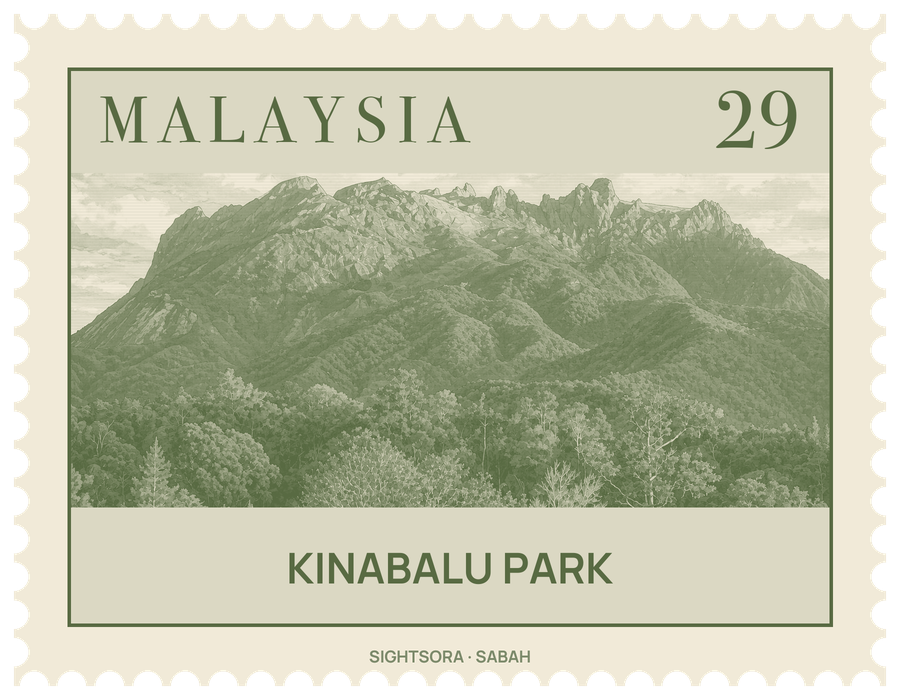
Gazetted in 1964 as Sabah's first park, after the Royal Society expeditions led by the botanist E. J. H. Corner, it was inscribed by UNESCO as a World Heritage Site in December 2000. Park headquarters stands at over fifteen hundred metres on the park's southern edge, about ninety kilometres from Kota Kinabalu by sealed road.
Walking uphill here means crossing a series of forest types. Lowland dipterocarp forest, covering about 35% of the park, mostly in the north and east, has trees up to 50 metres tall, with figs feeding monkeys, civets and hornbills. Above about 1,200 metres comes a lower canopy of oaks, chestnuts and conifers draped in moss, ferns and orchids; above about 2,200 metres, mist feeds a cloud forest where rhododendrons such as Low's rhododendron flower yellow. From about 3,300 metres, trees give way to low twisted shrubs, grasses and exposed granite. About 16% of the park lies on ultramafic soils, home to specialised plants such as the pitcher plants Nepenthes rajah and N. villosa and the slipper orchid Paphiopedilum rothschildianum.
Sabah Parks estimates the park's flora at 5,000–6,000 vascular plant species, among them 78 kinds of fig, 81 palms, 45 wild gingers and two Rafflesia species, and the moths and butterflies run to about 1,000 and 600 species. Its primates include orangutans and gibbons as well as tarsiers, slow lorises and leaf monkeys, along with endemics such as the black shrew, the Kinabalu shrew and Thomas's pygmy squirrel; birds range from the rhinoceros hornbill to the mountain blackbird of the high slopes. Even the leeches and earthworms are local, with the Kinabalu giant red leech and the Kinabalu giant earthworm found here.
At headquarters, the Conservation Centre combines park administration, research and education and holds the Geopark Gallery; nearby are a Botanical Garden and guided nature trails, and accommodation inside the headquarters area ranges from hostels to chalets. About 40 km away, Poring sits at about 400 metres in warmer lowland forest and takes its name from a giant bamboo, Gigantochloa levis. Its hot sulphur springs were first developed as baths during the Second World War, and around them are a Butterfly Farm, an Orchid Conservation Centre, a Rafflesia Garden and other gardens, with trails to two waterfalls: Kipungit, about 1 km from the springs, and Langanan, some 3.4 km off, with a bat cave on the way.
The park reaches well beyond the main mountain. Monggis Substation, about 45 km from Ranau town, is the starting point for Mount Tambuyukon, which reaches 2,580 metres above surroundings that rise from about 200 metres and supports a rich flora on ultrabasic soils. In Kota Belud, a substation founded in 1992 is known for its trail to the Kemantis Waterfall, and Serinsim, between the Serinsim and Kinarom rivers in Kota Marudu, is a base for local guided visits.