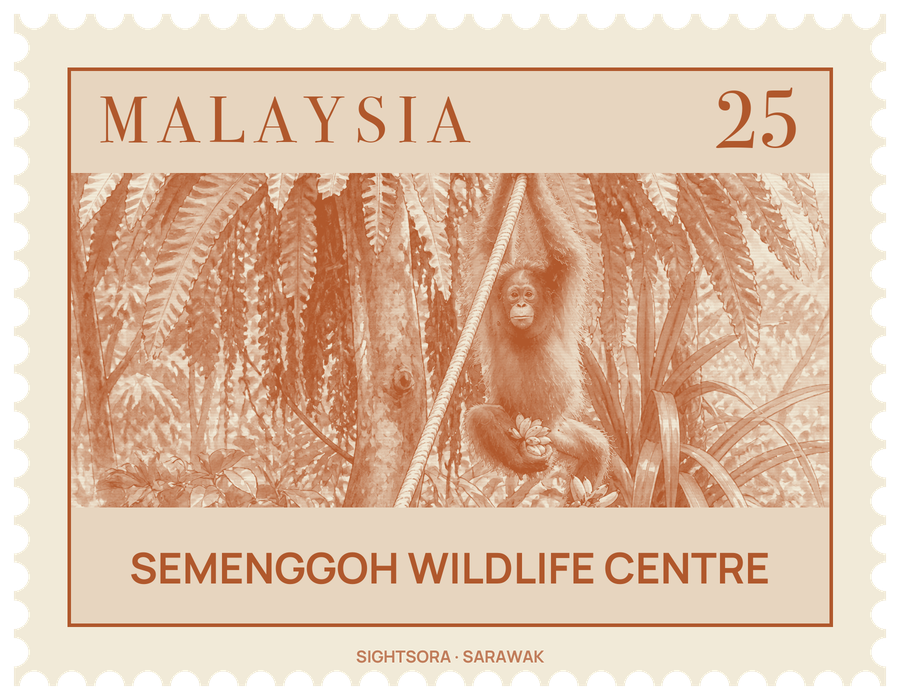
The Sarawak Forestry Corporation sets the centre three tasks: preparing animals for release back into the wild, research and breeding of endangered species, and teaching the public about conservation.
Many species have passed through its care, but the centre made its name with orangutan rehabilitation. So many orangutans were returned to the forest here that it reached its limit, and rehabilitation work moved to the Matang Wildlife Centre. Semenggoh now concentrates on the biology and behaviour of the apes, and its forest gives a home to semi-wild orangutans, among them young born in the wild to mothers that had been rehabilitated. Visitors come to watch them in their natural habitat.
The orangutan, Pongo pygmaeus, lives in the rainforests of Sarawak and Sabah, Indonesian Kalimantan and North Sumatra, and spends almost all its life in the trees. The name is Malay: orang means person and utan comes from hutan, forest. Mature males grow large cheek pads and a throat sac and can reach 150 cm in height and 100 kg in weight, while females are smaller. They feed mainly on fruit, but also take leaves, insects, bark and flowers, and build a fresh nest in the canopy every night.