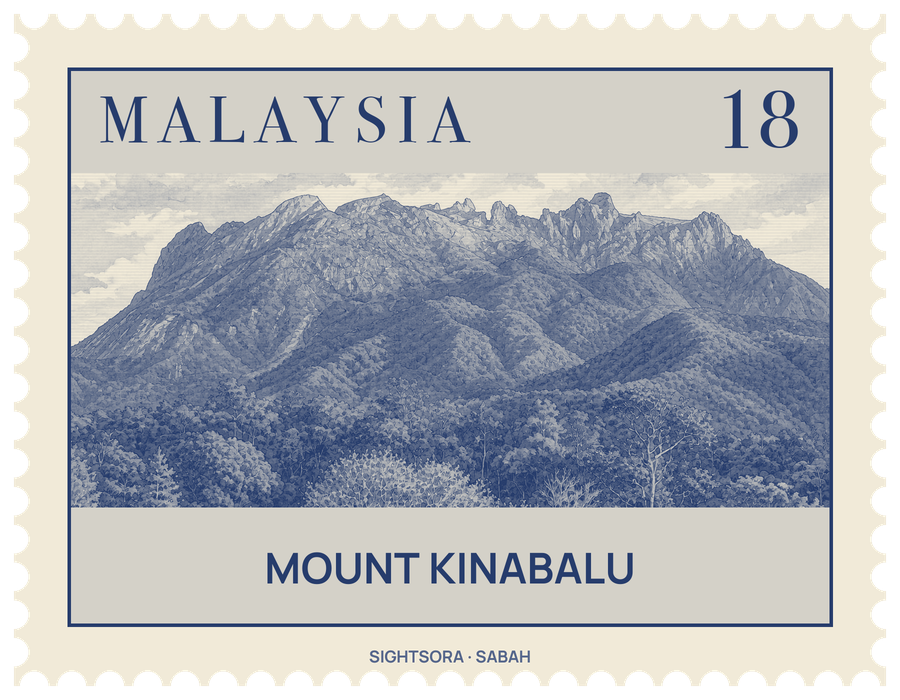
The whole mountain lies within Kinabalu Park. Its name is probably a shortened form of Aki Nabalu, "Grandfather Nabalu", the spirit that guards it, and the Liwan Kadazandusun call it Gayo Ngaran, "the Great Name", the object of yearly pilgrimages.
Geologically the mountain is young: it is a mass of granodiorite that pushed up through older rock as molten material and only cooled about 10 million years ago, and it is still rising by roughly 5 mm a year. During the Pleistocene, ice sheets and glaciers covered the upper slopes and scraped out the jagged summit, as well as Low's Gully, a gorge 1,800 metres deep on the north side. In 2022 the International Union of Geological Sciences included the Mount Kinabalu granite in its list of 100 geological heritage sites.
Climbing the mountain means passing from humid tropical forest at the base to alpine conditions at the top. Above 3,500 metres it is too harsh for trees, and higher still only tough grasses, sedges and dwarf shrubs survive in the cracks of the rock. At the summit, frost and ice appear on cold occasions, and snow has been seen there on just three occasions, in 1975, 1993 and 2022.
Most climbers start at the Timpohon Gate, at 1,866 metres and 5.5 km from park headquarters, and walk up to the Laban Rata Resthouse at 3,270 metres, usually in 3 to 6 hours. There are no roads to Laban Rata, so porters carry its supplies, sometimes more than 35 kg at a time. The climb is usually split over two days, with a night at Laban Rata; the final 2 km to Low's Peak, mostly over bare granite, take between 2 and 4 hours. Since 1987 the mountain has also hosted the Mount Kinabalu Climbathon, a skyrunning race.
The first recorded climb to the summit plateau was made in March 1851 by the British colonial administrator Hugh Low, guided by Lemaing, a Dusun from Kampung Kiau; Low judged the highest point beyond reach of anything but winged creatures. The zoologist John Whitehead stood on it in 1888, and in February 1910 the botanist Lilian Gibbs became the first woman to reach the top. On 5 June 2015 an earthquake and the landslide it set off killed eighteen people on the mountain, among them hikers and guides, and badly damaged Donkey Ear's Peak.