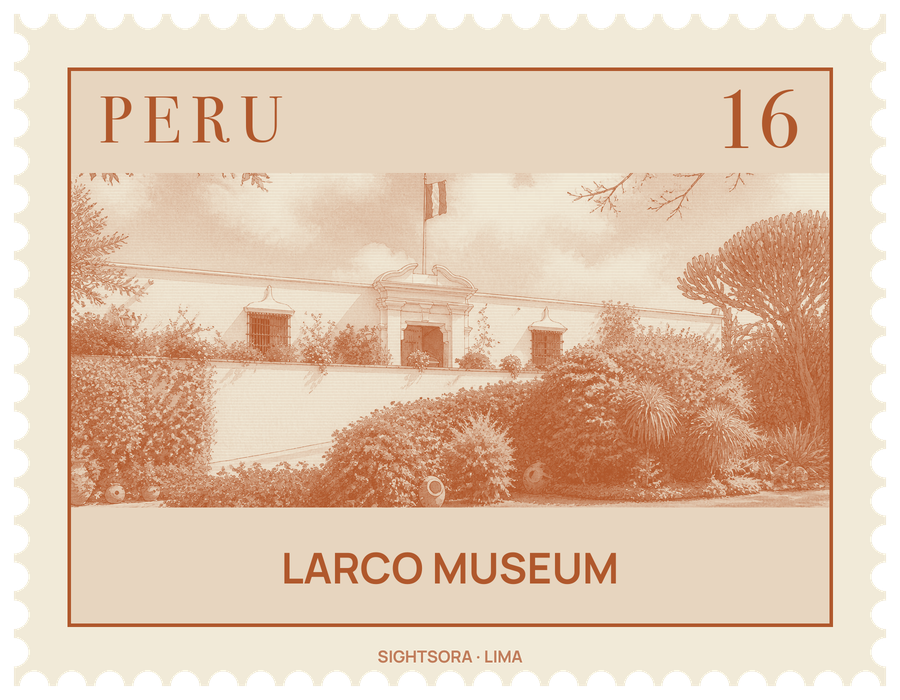
The museum is privately owned, its formal name is the Rafael Larco Herrera Archaeological Museum, and it occupies an 18th-century building from the time of the viceroyalty.
The collection began in 1925, when Rafael Larco Herrera acquired a collection of some 600 ceramic pieces that had belonged to his brother-in-law, Alfredo Hoyle, and left them in the care of his son, Rafael Larco Hoyle. Urged by his uncle Victor Larco Herrera to found a museum that could protect objects being dug up by clandestine excavators, the younger Larco bought two big collections of 8,000 and 6,000 pieces, along with smaller ones from the Chicama Valley, Trujillo, Virú and Chimbote. Display cases went into a small house on the Chiclín estate, and the museum opened its doors on 28 July 1926, Peru's Independence Day.
The galleries follow the map and the timeline of ancient Peru. The Cultures Gallery is split into four areas — the North Coast, the Center, the South and the highlands — with cases set out in cultural order: Cupisnique, Vicus, Mochica and Chimu in the north; Lima and Chancay on the central coast; Paracas, Nazca and Chincha in the south; and Chavín, Tiahuanaco, Huari and Inca in the highlands. The Gold and Silver Gallery holds the regalia of rulers: crowns, earrings, nose ornaments, masks and vases worked in gold and set with semi-precious stones. Further rooms cover stone, ceramics, metals and textiles, and in the storage rooms visitors can look over the museum's whole classified collection.
The erotic pottery gallery gathers pieces that Rafael Larco Hoyle found in the 1960s while studying sexual imagery in ancient Peruvian art, research he published in 1966 in the book "Checan". The vessels belong to a wider habit of the old cultures of Peru, which recorded their everyday life in clay. The museum shop sells ceramic, metal and textile reproductions made by craftsmen from across Peru, and the museum lends part of its collection to the Museo de Arte Precolombino in Cusco. The building is at 1515 Simón Bolívar avenue in Pueblo Libre, with the entrance on Navarra street, opposite the Larco park.