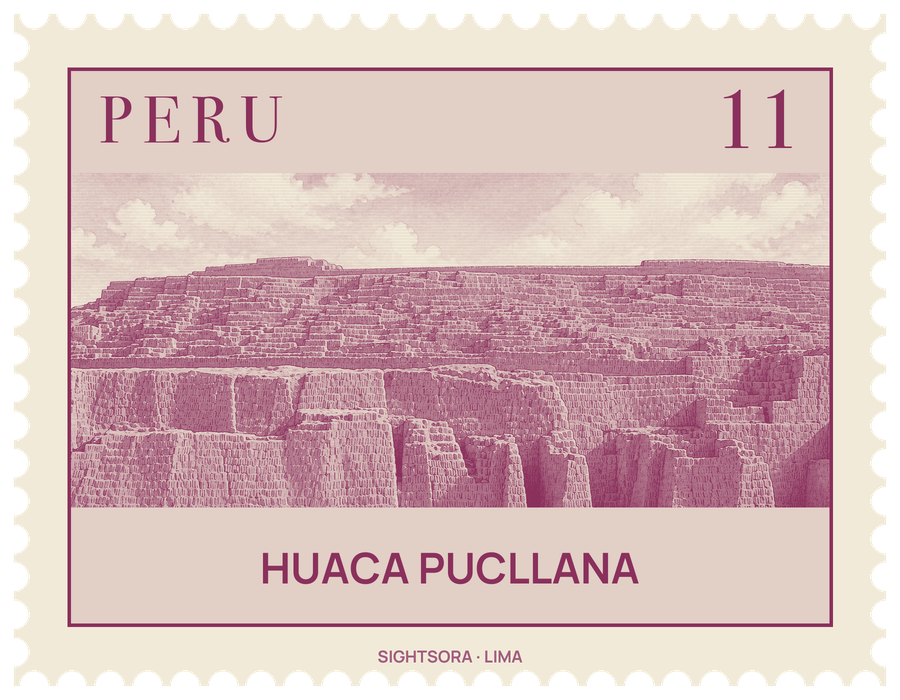
It was raised by the Lima Culture, which flourished on Peru's central coast between about 200 AD and 700 AD, and served as one of its main ceremonial and administrative centres. Its priestly elite, who governed several neighbouring valleys, used the Great Pyramid to display their religious power and their claim to control the area's water, both fresh and salt.
The complex is wrapped by a plaza along its outer edge and cut in two by a long dividing wall. One half was ceremonial, with benches and deep pits where fish and other sea creatures were offered to win the gods' favour. The other half was administrative: small clay structures and adobe huts, some with walls still upright, formed the courtyards and patios of an enclosure more than 500 metres long, 100 wide and 22 high.
Remains have also been found from the Wari Culture, which flourished between 500 and 1000 AD and strongly influenced Lima society in its final period. The best-known find is the tomb of the "Señor de los Unkus", the first burial in the ceremonial centre to be uncovered completely intact: it held three funerary bundles with the remains of three adults, two of them wearing masks, together with a sacrificed child. The name may come from the Quechua wak'a, a sacred place or shrine, and pukllana, "game", or may recall a pre-Inca local chief.