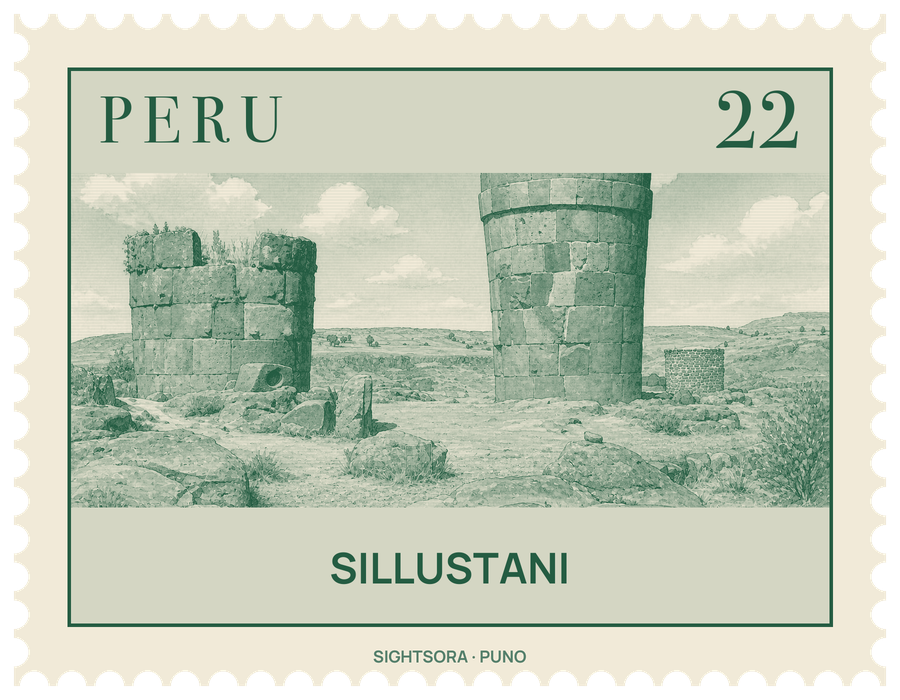
The towers, called chullpas, hold the dead above ground rather than below it, and they were left by the Qulla, most likely a Puquina-speaking people, whom the Inca Empire conquered in the 15th century. Each housed a whole family group, probably of noble rank.
Inside, the tombs were built for extended families. The bodies were not deliberately mummified, but the dry air of the sealed chambers kept them for centuries, most of them bundled in a fetal position. The only opening of each tower faces east, where the Sun was believed to be reborn from Mother Earth every morning. Some stones are carved with animal figures, and many towers show pre-Inca work later faced with Inca stone blocks.
Chullpas appear across the Altiplano, and above-ground burial of this kind goes back at least to the Tiwanaku period, but the group at Sillustani is unusually well kept. A large ramp still rests against one tower, showing how stones were hauled up onto the walls, and a few big blocks lie on a ramp leading to a chullpa that was never finished. Grave robbers blew many tombs open with dynamite. Some towers have been restored, among them during a 2005 project led by the archaeologist Eduardo Arizaca Medina, whose team set the stones with wooden ramps and pry bars.