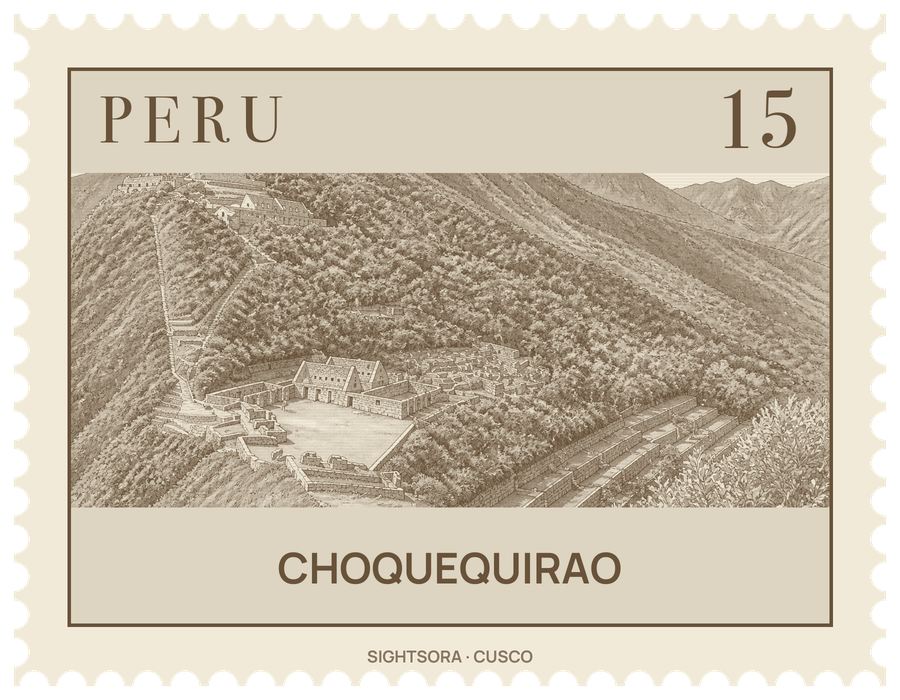
Its layout and stonework have earned it the nickname of Machu Picchu's "sister city", but the ruins are approached on foot, by trails that take more than a day. The name is usually translated as "Cradle of Gold", combining the Aymara word for gold with a Quechua word for a cradle.
The city seems to have been founded by Pachacuti and enlarged by his son Tupac Inca Yupanqui, and some of its decoration is in the style of the Chachapoya, whose workers probably helped build it. It acted as a ceremonial and administrative centre, a checkpoint on the way into the Vilcabamba region and a link between Cusco and the Amazon forest; after the conquest it was one of the last refuges of Manco Inca's resistance. Abandoned in the late 16th century, it was swallowed by forest and became a legend that drew 19th-century explorers. Hiram Bingham came in 1909 hoping it was the lost Inca capital, but judged it a frontier fortress and kept searching.
The main temples, elite houses, shrines and baths are grouped on the ridge top around two plazas. The buildings and terraces step up and down around Sunch'u Pata, a hilltop that was flattened and ringed with stone long ago to form a platform of 30 by 50 metres, and the usnu, a ceremonial hill levelled into an oval platform, looks out over the main square, the snowy peaks and the Apurímac. On the main platform the Giant Stairway, 25 metres long and 4.4 metres wide, ends abruptly halfway down the slope; it faces the sunrise of the December solstice, when the boulders on its steps light up. Stone channels carried water to shrines and baths across the site.
Choquequirao's best-known feature lies on the western side, in Sector VIII, where 80 farming terraces are cut by water channels running down from the main plaza. Into the dark schist of the terrace walls the builders set the "Llamas del Sol": twenty-five figures of llamas laid in white stone, between 1.25 and 1.94 metres tall, among them llamas carrying loads beside their herders, with a zigzag band of the same pale stone on the highest wall. Elsewhere the walls were plastered with clay and painted a light orange, since the local rock could not be cut as finely as at Machu Picchu.
Getting there
Choquequirao is reached by a hike of more than one day. The usual trail begins in San Pedro de Cachora, a village about four hours' drive from Cusco on the road to Abancay. A second trail of 15 kilometres starts from Huanipaca, whose turn-off is on the same road 4–5 kilometres past the one for Cachora. Longer treks continue from Choquequirao to Machu Picchu over the Yanama Pass at 4,668 metres.