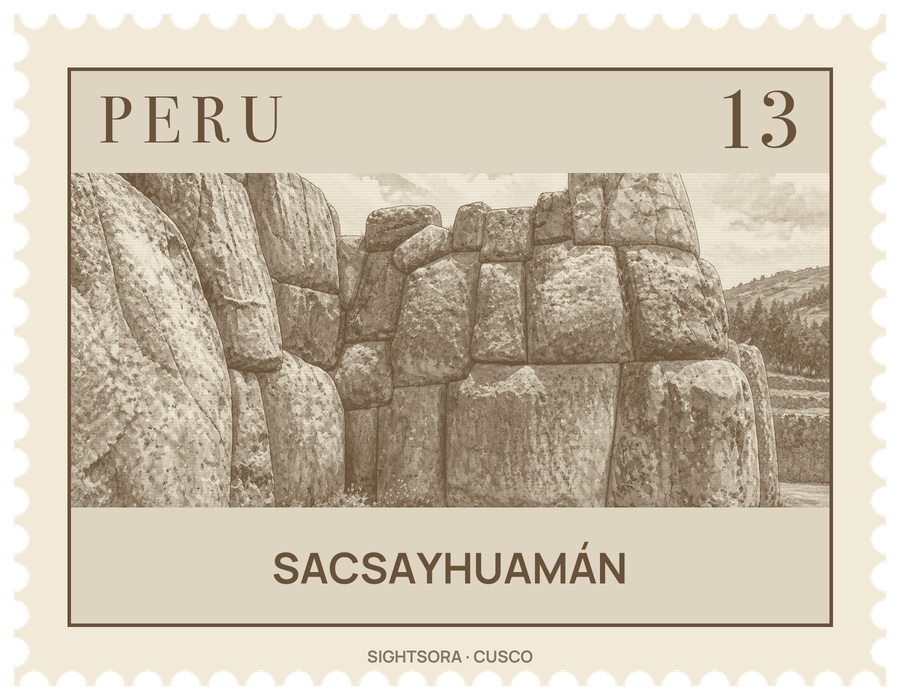
Its Quechua name is usually translated as "fortress of the royal falcon". In 1983 it was inscribed on the UNESCO World Heritage List together with Cusco itself.
Pottery found on the surface shows that the hilltop was occupied by about 900 CE, but the great works are Inca. Inca oral history credits them to Pachacuti and his successors, and tells that Pachacuti had imagined Cusco as a lion, with the meeting of its two rivers as the tail and the main square as the body; a fortress on the high ground to the north was to be its head. The Spanish chronicler Pedro Cieza de León, who saw it twice in the 16th century, wrote that 20,000 men from the provinces worked on it in rotation, some quarrying, some hauling stone with ropes of leather and fibre and some preparing foundations.
The three terrace walls beside the plaza are the part most people come to see. The longest runs for about 400 metres, they stand around 6 metres high, and the largest limestone block weighs well over 100 tonnes. The stones are shaped to lock together so closely that a sheet of paper cannot slide between many of them, and their rounded corners, varied interlocking shapes and slight inward lean are thought to have helped them ride out Cusco's earthquakes. When Pizarro's men reached Cusco, Pedro Pizarro described the fort with two very tall round towers and rooms stocked with weapons and shields.
What visitors see is a fraction of the original. After the siege of Cusco the Spanish used the site as a quarry and within a few years had dismantled much of it, carrying off its smooth masonry for colonial churches, government buildings and the houses of wealthy Spaniards; mostly the stones too large to move were left behind. The rougher upper retaining walls in some sections are modern additions to control erosion. The large plaza, built for gatherings of thousands, still serves for ceremony: Peruvians stage Inti Raymi, the yearly Inca celebration of the winter solstice and the new year, near the walls, and the Warachikuy festival is held here each year.