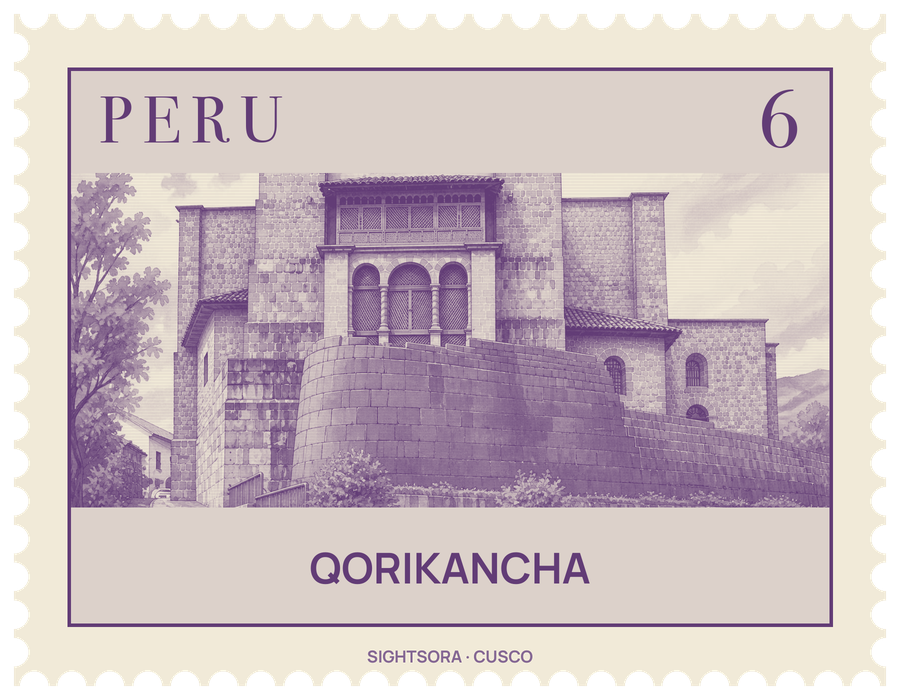
The Quechua name, Quri Kancha, means "golden temple"; it was first called Intikancha or Intiwasi, the house of Inti, the sun god, and the high priest lived here and led its rites. Inca tradition placed it where two rivers meet, the spot where Manco Cápac chose to found the temple, the city and the empire.
Pachakuti Inca Yupanqui rebuilt both Cusco and this House of the Sun, adding oracles and new buildings and covering it in plates of fine gold. Its walls were sheathed in gold sheets and the neighbouring courtyard was filled with golden statues, and he set the bodies of seven earlier Inca rulers, decked in gold masks and ornaments, on a golden bench. The Mama-cunas, cloistered women who served the temple, wove and dyed its woollen cloth and brewed chicha. When the Spanish demanded a ransom in gold for the emperor Atahualpa in 1533, most of it was stripped from here.
After the conquest the settlers demolished most of the temple and carried off its stone for their own churches and houses; the first Dominican convent fell in the 1650 earthquake and the present one rose over the Inca base. Later earthquakes badly damaged the church, but the Inca walls, built of large, tightly locked ashlar blocks cut to shape by hand and laid without visible joints, stayed standing. The Inca refused any stone with a flaw or crack, and the sheer labour involved was itself a statement of imperial power.
Inside the convent, four rooms of the old temple survive, with sloping walls and fragments of grey andesite, diorite and limestone once carved into ceremonial niches, walls and channels. One block in the second course has three holes, perhaps for draining rain or chicha offerings from the patio; the Peruvian folklorist Augusto León Barandiarán found that striking them sounds the notes D, A and G. The outer wall is made of pink and grey granite whose inner face shows a vitrified layer that reflected light at night. The semicircular wall of the sun temple belongs to the same family as the Torreón at Machu Picchu and the sun temple at Písac, all three used to follow the solstices, and an underground archaeological museum close by displays mummies, textiles and sacred figures from the site.