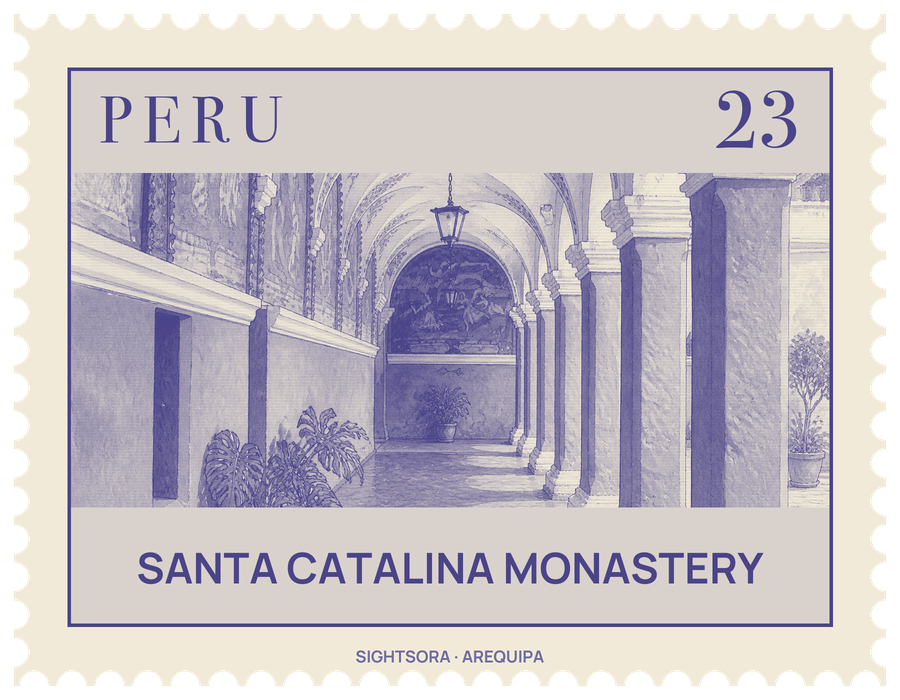
Founded in 1579, it stayed closed to the outside world for almost four centuries, and a community of nuns still lives in its northern part.
Viceroy Francisco de Toledo licensed the foundation, and its first prioress was María de Guzmán, a widow who gave up all her property to enter. Earthquakes destroyed the early buildings in 1600 and 1604, and the present buildings belong mostly to the late 17th century. The nuns came largely from wealthy criollo and mestizo families, although some "poor nuns" were admitted without a dowry, and by the middle of the 18th century more than 300 women, nuns and servants together, lived inside. A large part of the convent opened to the public in 1970.
The stone comes in two colours: white tuff from the Chachani volcano and pink tuff from Misti. Because earthquakes kept damaging the buildings, the nuns' families built each woman her own private cell, so some quarters are neatly ordered while others grew without any plan, their walls, roofs, patios and doorways put up by masons working without an architect's design. Flying buttresses, strong arches on pillars, domes and vaults give the larger buildings their weight. The chapel has a Baroque altar of carved and gilded wood, and several paintings of the Cusco School hang in the complex.
The Pinacoteca, the monastery's art gallery, shows around 400 colonial works in two large vaulted halls arranged in a cross, their plaster removed to bare the ashlar walls, with a smaller vault beside them. Among the bells, the oldest, facing Ugarte street, carries the inscription "Santa Catalina Ora Pronobis, 1749", and the one facing Bolívar street bears the name of María de Villegas and the year 1787. The monastery was declared Cultural Heritage of Peru in 1944 and belongs to the Historical Centre of Arequipa, which UNESCO inscribed in 2000.