Two basins make up the lake, joined by the Strait of Tiquina, just 800 metres wide at its narrowest: the large Lago Grande, which reaches 284 metres deep, and the shallow Wiñaymarka. Five main rivers and more than 20 streams feed it, and of its 41 islands some are densely populated. For the Incas it was a sacred, mythical lake and the goal of pilgrimages.
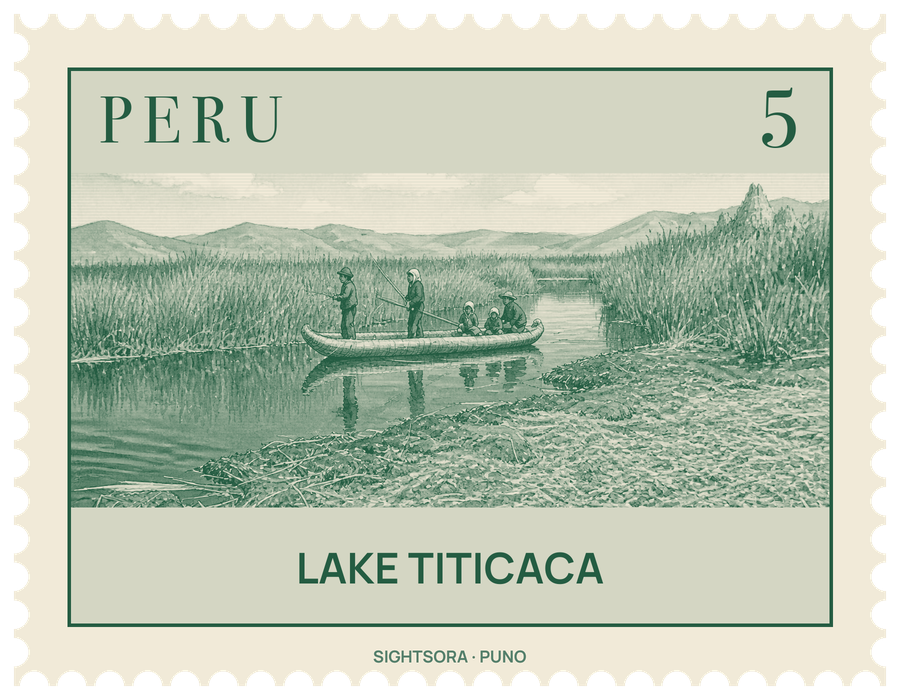
The best-known sight on the Peruvian side is the Uros islands, small floating platforms that the Uros people build from layers of totora, a buoyant sedge that grows in the shallows, topping them up with fresh reeds again and again. Many are about 15 by 15 metres, golden in colour, each with a few thatched reed houses for an extended family, and some with reed watchtowers. Legend says the Uru came from the Amazon and built movable islands to escape hostile neighbours on land. After a great storm in 1986 many rebuilt nearer the shore, and the islands now cluster in the lake's western corner near Puno, where the Uros carry visitors out by motorboat and sell handicrafts.
Farther out, Taquile is a long, narrow hilly island whose main village sits at 3,950 metres, with pre-Inca ruins on its summit, terraced fields on its slopes and a view across to the Bolivian mountains. A prison in colonial times and into the 20th century, it became the property of the Taquile people in 1970. Its textiles are famous: UNESCO has listed "Taquile and Its Textile Art" among its masterpieces of humanity's oral and intangible heritage, and here knitting is done only by men, from the age of eight, while women spin and weave. The islanders run their own tourism, with homestays, transport and restaurants, and order community life around the old Inca rule against stealing, lying and laziness (ama sua, ama llulla, ama qhilla).
Amantani, home to Quechua speakers, rises to two peaks called Pachatata and Pachamama, each crowned with ancient ruins, above hillsides of terraced wheat and potato fields divided by long stone walls. There are no cars or hotels, and some families take guests into their homes overnight and cook for them. On the Bolivian side, Isla del Sol, where Inca religion placed the birth of the sun god, holds more than 180 ruins, among them the Sacred Rock and the labyrinth of Chinkana, and nearby Isla de la Luna has an Inca building raised over a Tiwanaku temple.
The lake also has a long history of steamships, all built in the United Kingdom as kits of bolted parts and reassembled on the shore. The Yavari, launched in 1870, and the Yapura were designed for the Peruvian Navy to carry cargo and passengers and to serve as gunboats; the Coya, launched in 1893, was turned into a floating restaurant in 2001; and the much larger Ollanta, whose parts came up by rail to Puno, was launched in 1931.
Getting there
Puno is the lake's main Peruvian port, and the Uros islands lie close by in the western corner of the lake; Taquile is 45 kilometres east of Puno. On the Bolivian side, boats run regularly between Copacabana and Isla del Sol. A rail ferry also links PeruRail's line at Puno with the Bolivian railway at Guaqui.