Villages of the Collagua and Cabana peoples line the valley, most of them founded as colonial towns, and their communities keep up ancestral customs, crafts and festivals such as the Wititi of Chivay, recognised as part of Peru's cultural heritage.
Before the Incas, the Quechua-speaking Cabanas and the Aymara-speaking Collaguas, who came from the Lake Titicaca region, shared the valley; the Incas probably arrived around 1320 AD and took control through marriage rather than war. In the 1570s the viceroy Francisco de Toledo forced the scattered population into planned settlements, and these remain the main towns. Franciscans built the valley's first chapel in 1565 and its first church in 1569, and the churches hold notable religious art. High on the cliffs, faint red marks still show where the Collaguas dug and painted tombs for their dead.
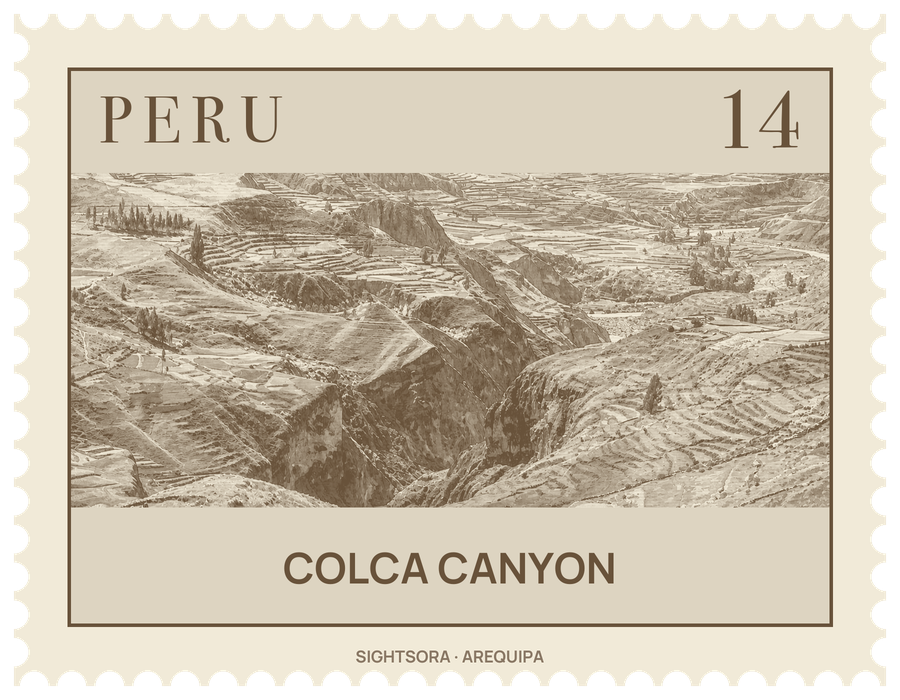
Chivay, the largest town, lies halfway along the valley and has the La Calera hot springs; above it the land turns to pasture for alpacas and llamas, while below it terraces cover the slopes for many kilometres. Small villages are strung over the roughly 56 kilometres from Chivay to Cabanaconde, and beyond, around Huambo, the river drops to 1,066 metres. Near Cabanaconde the canyon floor holds an oasis with several resorts, and to the southeast stands the snow-capped extinct volcano Ampato, 6,288 metres high.
A favourite sight is the Andean condor, seen at close range as the birds glide past the canyon walls; the viewpoint of Cruz del Condor looks down 1,200 metres to the canyon floor. The valley is also home to the giant hummingbird, Andean goose, Chilean flamingo, vizcacha and vicuña. Caves in the valley hold paintings and carvings more than 7,000 years old showing hunting scenes, llamas, foxes and the sun, and the Caves of Mollepunko above Callalli have rock art of alpaca herding. A day trip from Tuti reaches a spring at 5,120 metres where meltwater from Mismi bursts out of the rock, the most distant source of the Amazon, and the Infiernillo Geyser on Hualca Hualca can be reached on foot, on horseback or by mountain bike. Some families take in guests in casas vivenciales, sharing their daily life.