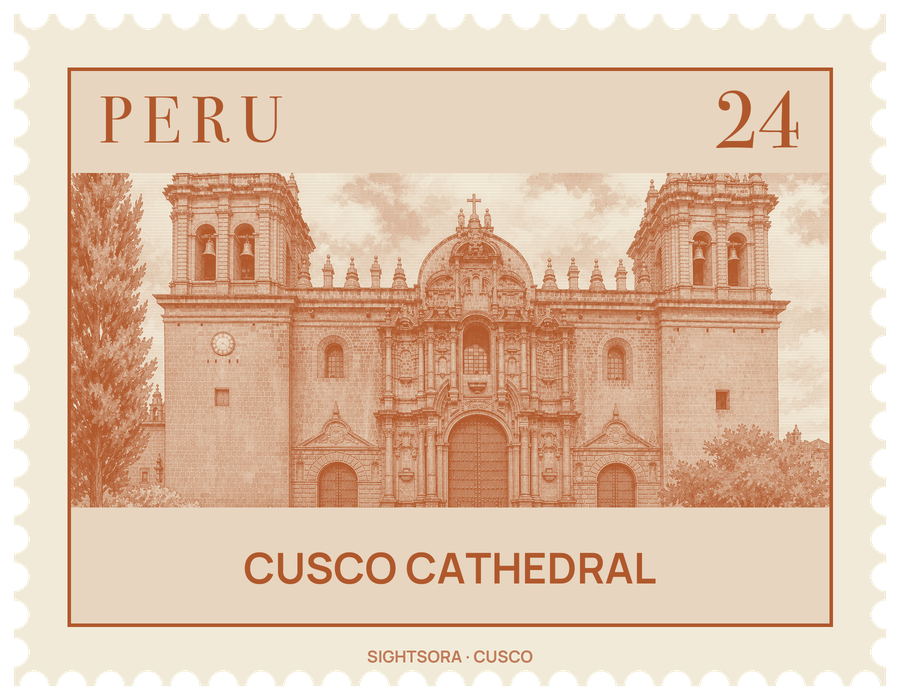
Dedicated to the Virgin of the Assumption and ranked as a basilica, it is the seat of the Archdiocese of Cusco and forms a cathedral complex of 3,920 square metres together with the smaller Triunfo church. Both stand inside the historic centre that UNESCO listed as a World Heritage Site in 1983.
After the conquest the Spanish pulled down the Inca buildings on this prominent site to put up a Christian church. The little Iglesia del Triunfo, raised over the Suntur Wasi, was the first cathedral of the city and now serves as a side chapel. Work on the main building started in 1560 and passed through a series of architects; it halted when Viceroy Francisco de Toledo came to Cusco and resumed in 1615 under Miguel Gutiérrez Sencio, an admirer of the sober Herrerian style, working with Francisco Becerra. The first mass was said on 15 August 1654, and the cathedral was consecrated on 19 August 1668. Builders used stone from the surrounding area and reused red granite blocks taken from the fortress of Sacsayhuamán.
The earthquake of 1650 brought down the ribbed vault and led the builders to change the upper part of the façade and give up a third level on the towers, which is why the towers look short and the whole building so heavy. The church has a rectangular hall plan with three naves, matching the three doors in the façade. Fourteen cross-shaped pillars of andesite carry twenty-four Gothic rib vaults, while the chapels are roofed with groin vaults. The façade on the Plaza de Armas is Renaissance with Baroque touches, and the interior mixes late Gothic, Baroque and Plateresque work with colonial gold work and carved wooden altars. The Incas left a trace of their own symbolism on the doors, where a carved jaguar head appears.
Much of the art inside comes from the Cusco School, where Quechua and criollo painters were trained in European methods and limited to Christian subjects; they were not allowed to sign their canvases, so most remain anonymous. One large 17th-century painting shows the whole city during the 1650 earthquake, with townspeople carrying a crucifix around the Plaza de Armas and praying for the shaking to stop. Nearby hangs a portrait of Vicente de Valverde, the friar who came with Francisco Pizarro and became bishop of Cusco, and surviving canvases from Diego Quispe Tito's series on the parables of Christ, completed in 1681 to stand for the twelve months and signs of the zodiac. The cathedral is also home to the venerated image of the Lord of the Earthquakes.
The Iglesia del Triunfo takes its name from the Inca siege of Cusco led by Manko Inka, when the Spanish made a last stand in the Suntur Wasi and drove the attackers back. They credited the victory to Saint James, and a statue inside the church shows him on horseback striking down an Inca.