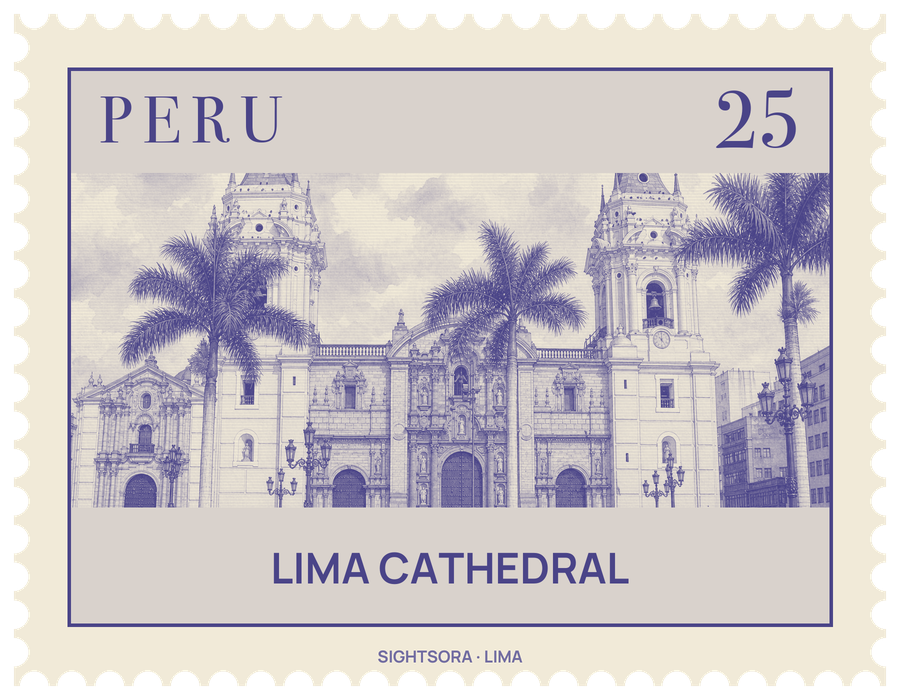
The archbishops of Lima have their seat here, and the church is dedicated to Saint John the Apostle and Evangelist. Francisco Pizarro laid its first stone in 1535, though the building in its present form went up between 1602 and 1797. It belongs to the Historic Centre of Lima, a UNESCO World Heritage Site since 1991.
The first church here was a modest one finished in 1538, and a second, just 9 by 19 metres, opened in 1552 after Pope Paul III made Lima a diocese. The present layout goes back to Francisco Becerra, who was called from Cusco in 1585 and drew a Renaissance hall church of three naves with side chapels, partly modelled on the cathedrals of Jaén and Seville. Earthquakes struck the work again and again; after the one of 1746 left it close to ruin, the Jesuit Juan Rher rebuilt it to the old plans, using wood and quincha for the ribbed vaults, and Matías Maestro finished the bell towers between 1794 and 1797.
The façade is Renaissance with Plateresque ornament, flanked by Neoclassical towers with slate spires. Three doors face the square: the central Puerta del Perdón, with the Puerta de la Epístola and the Puerta del Evangelio to either side, under statues of the Apostles and the Sacred Heart of Jesus in the middle niche. A side door opens onto the Patio de los Naranjos, an inner courtyard. The left tower holds the bell called la Cantabria, cast in Lima, and the right tower la Purísima and la Vieja.
Inside, Gothic ribbed vaults of wood and stucco are made to look like a starry sky; the light materials spare the walls in an earthquake. Large paintings of the Via Crucis line the side naves. From 1804 most of the Baroque altars were replaced with Neoclassical ones, much of this work led by Matías Maestro, who also made the four statues of saints in the transept. The 17th-century choir stalls, designed by Martín Alonso de Mesa and made by Pedro de Noguera, are covered with carved saints and now stand on either side of the main altar, where an Immaculate Conception presides. Two plaques by the entrance recall the visits of Pope John Paul II in 1985 and 1988.
To the right of the entrance, a chapel lined with mosaics of the Conquest holds the tomb of Francisco Pizarro, with a small chest of earth from his home town of Trujillo in front. A mummified body displayed here from 1891 was long taken to be his, until workers in the crypt found a lead box in 1977 whose inscription said it held his head; bones found with it were later identified as his. Another chapel holds the tomb of Nicolás de Ribera, the first mayor of Lima, and most of the city's archbishops lie in a crypt below the presbytery. Beyond lie the ante-sacristy with twelve zodiac paintings from the Bassano workshop, the sacristy with a carved chest of drawers by Juan Martínez de Arrona, and the Chapter House, where vestments worn by John Paul II in Peru are on show.