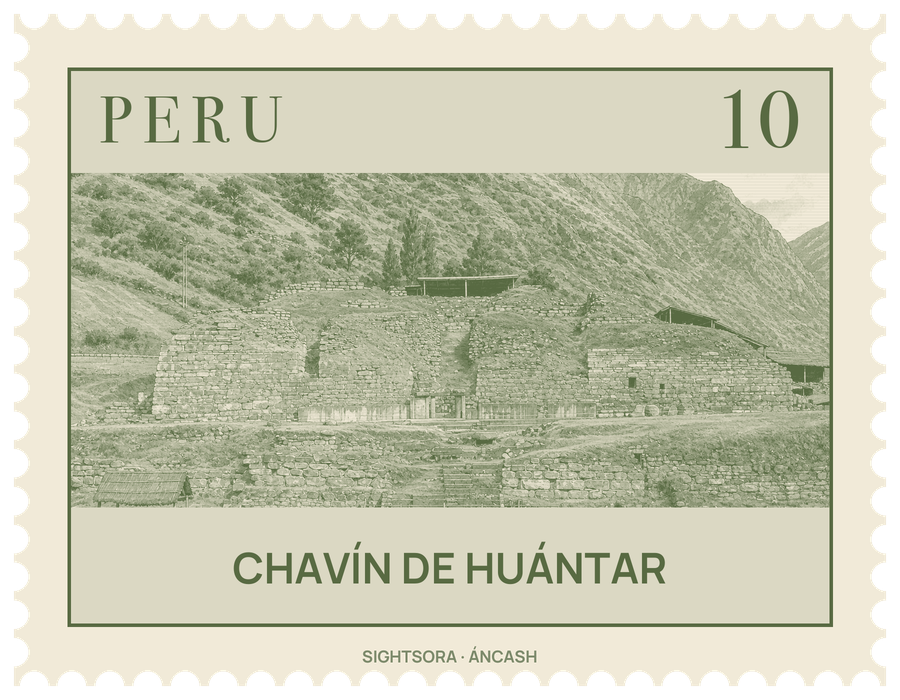
It was the religious centre of the Chavín, one of the great cultures to flourish long before the Incas: construction began before 1200 BC and most of the major building was finished by 750 BC. People came here from across the region to take part in rituals, consult an oracle or join a cult. The site is a UNESCO World Heritage Site, and the Peruvian archaeologist Julio C. Tello called it "the birthplace of South American culture".
The main temple is a massive flat-topped pyramid flanked by lower platforms around a U-shaped plaza. Its oldest part, known as the Old Temple, faces inwards: a warren of passages built around a circular court, with obelisks and stones carved in relief with jaguars, caimans and creatures that are part human. At its very centre, in the Lanzón Gallery, stands the Lanzón, a carved figure with a feline head and a human body, taken to be the supreme deity of Chavín. In the later New Temple the same god appears holding a strombus shell in one hand and a Spondylus shell in the other.
Ringed by Temples A, B and C, the Circular Plaza is almost exactly round and close to 20 metres across, paved with pillow-shaped slabs of yellow diatomite, with a line of black limestone blocks along its east–west axis and walls of cut granite. Later builders enlarged the complex and added a bigger sunken rectangular plaza so that more people could gather at once. Chavín sculpture is typically of white granite and black limestone, and finds from the site include carved mortars and pestles, conch-shell trumpets and decorated pottery and textiles; some are on display in Lima's Museo de la Nación and in the Museo Nacional de Chavín in the town.
The setting was part of the meaning. The meeting of the Mosna with a second river was a tinkuy, a harmonious union of opposing forces, and the valley offered hot springs and a view of the Wantsan peak. From around 500 BC the ceremonial centre declined, and a small village grew over the Circular Plaza, its houses built partly with salvaged temple stones and carvings. In 2018 a team led by John Rick of Stanford University sent four-wheel-drive robots into the temple and found 30 tunnels and several burials.