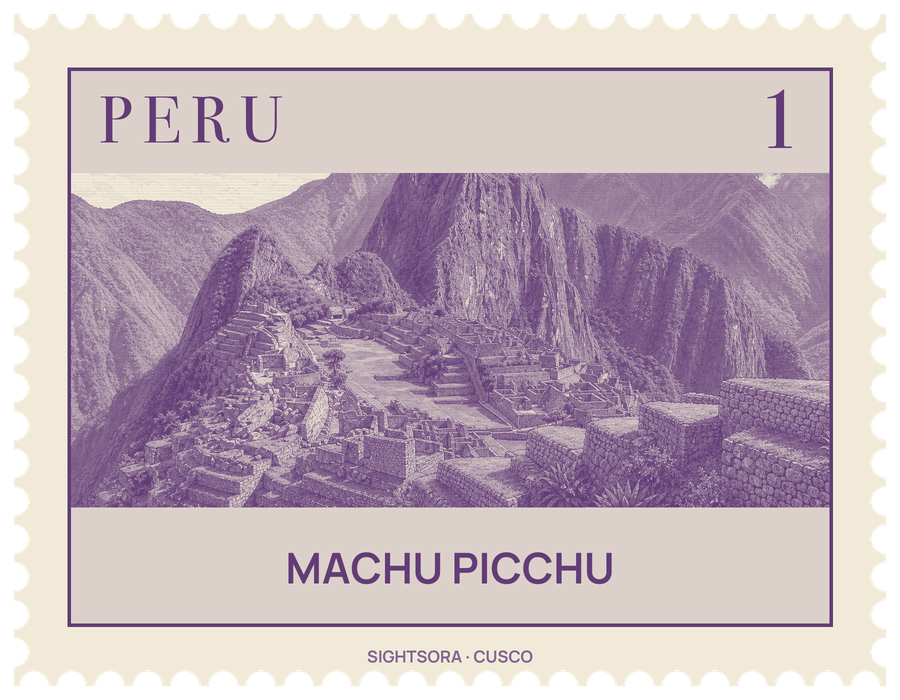
Below it the Urubamba River curls around the site on three sides, and cliffs fall 450 metres to the water, so morning mist often rises up from the valley. Peru declared the surrounding area a Historic Sanctuary in 1981, and UNESCO inscribed it in 1983 as both a cultural and a natural World Heritage Site.
Archaeologists broadly agree that the emperor Pachacutec ordered the estate built after conquering the middle and lower Urubamba, and radiocarbon dating of human remains points to occupation from around 1420 to 1530. About 750 people are thought to have lived here, most of them retainers drawn from many parts of the empire, before the place was left empty around the time of the Spanish conquest. The jungle then covered it. In 1902 the Peruvian explorer Agustín Lizárraga reached the ruins and left his surname and the date in charcoal on the middle window of the Three Windows temple; in 1911 a local farmer, Melchor Arteaga, led Hiram Bingham of Yale up the slope, and Bingham's reports made the site known around the world. Thousands of objects he took to Yale were returned to Peru between 2010 and 2012 and are on permanent display at the Casa Concha museum near the colonial centre of Cusco.
The citadel splits into two parts: an agricultural sector of terraces to the southeast and an urban sector of houses, temples and storerooms, which in turn has two halves, Hanan above and Hurin below. Around 200 buildings stand on broad parallel terraces either side of a central square, linked by stone stairways set into the walls. The terraces themselves were engineered in layers of large stones, gravel, sand and topsoil carried up from the valley, so that the heavy rain drained away instead of washing the mountain down.
In Hanan, the courtyards of the Sacred Plaza hold the Main Temple and, on the east side, the Three Windows temple, whose single wall of white granite blocks is pierced by three large trapezoidal openings looking out over the ruins and mountains. Above them, on a stepped platform, stands the Intihuatana, a carved ritual stone whose Quechua name means "place where the sun is tied"; around 11 November and 30 January the midday sun stands almost directly over it and it casts no shadow. The Torreón is a curved tower built over a cave-like hollow among granite boulders, with some of the finest ashlar on the site and openings that catch the sunlight; a small doorway beside it gives a view across to Huayna Picchu.
In Hurin, three symmetrical compounds of houses and workshops face the Main Square, and nearby the Temple of the Condor combines ritual caves with a large carved stone often read as a condor. Just north of it, the cave of Inti Mach'ay has a tunnel-like window aligned so that the sun reaches inside on just a handful of days near the December solstice; on that solstice noble boys were initiated into manhood here. Throughout the site the masonry is dry-laid without mortar, with trapezoidal doors and windows, rounded corners and walls that lean slightly inward, features that helped the buildings ride out earthquakes on this fault-lined mountain.
Getting there
The usual approach is by train from Cusco or Ollantaytambo, run by PeruRail and Inca Rail, to the town of Aguas Calientes on the Urubamba below the ruins; from there a bus covers the 8.6 kilometres up to the entrance, or visitors can walk. The Inca Trail is a walking route of up to about 42.5 kilometres that starts at Km 82 or Km 104 of the railway, crosses a pass at 4,200 metres and enters the site through the Inti Punku (Sun Gate). A third option is to travel by road to the Hydroelectric station and walk or take a short train ride on to Aguas Calientes.