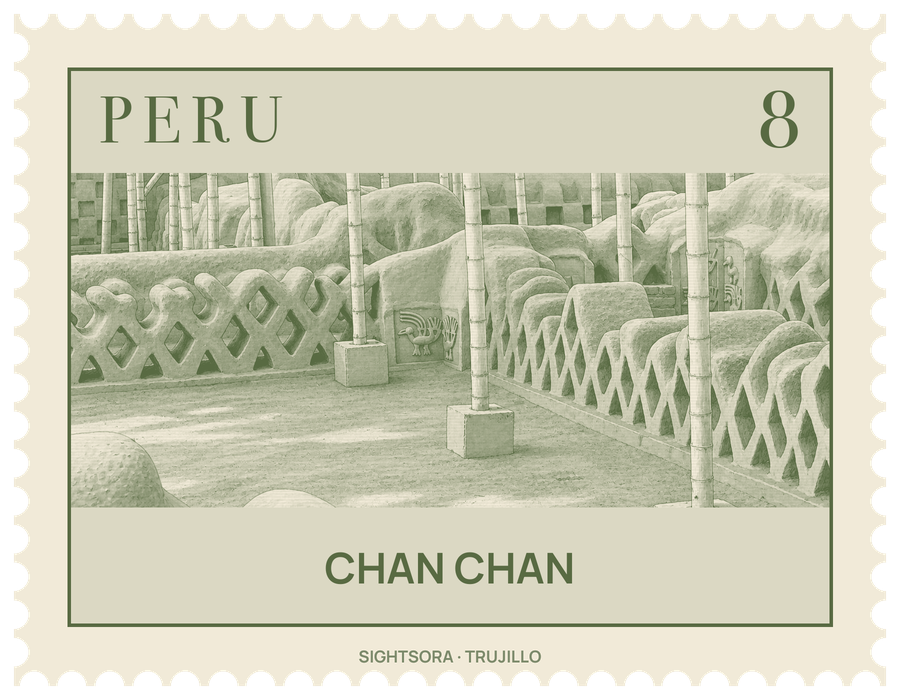
It was the capital of Chimor, the kingdom of the Chimú, until the Incas conquered it around 1470, and at its height it is estimated to have held 40,000 to 60,000 people. UNESCO inscribed it in 1986 and in the same year declared it a World Heritage site in danger, a status it has kept since.
The city covered about 20 square kilometres, with a dense core of six square kilometres. Its heart was a group of ten walled ciudadelas, palace compounds for the Chimú rulers with plazas, ceremonial rooms, temples, reservoirs, storerooms and burial platforms; only four have been recovered. Around them were courts known as audiencias, mounds called huacas and the cramped quarters of artisans, whose small, irregular rooms doubled as workshops for the textiles and ceramics the Chimú were famous for. Massive walls of 15 to 18 metres enclose the whole, with no compound opening to the north, since the north-facing walls caught the sun and broke the wind.
The best-studied compound, Tschudi, shows how much the Chimú lived by the sea. Its high reliefs show fish swimming both north and south, often read as the cold Humboldt and the warm El Niño currents, along with waves, fishing nets, pelicans and creatures that mix sea lion and otter. A pond at its centre was probably used for water rituals, and its single entrance and walls up to twelve metres high, five metres thick at the base and one at the top, served both defence and an earthquake-prone coast.
Water shaped the city's fate. It first drew on wells about 15 metres deep, then on long canals from the Moche River that allowed it to grow; the Incas are thought to have weakened it by cutting that supply. After 1535, when Francisco Pizarro founded Trujillo nearby, the Spanish looted its tombs. Today the greatest danger is rain: El Niño storms soak the bases of the unbaked walls, bringing salt and plant growth, and conservators have worked on rain covers and faster drainage to protect them.