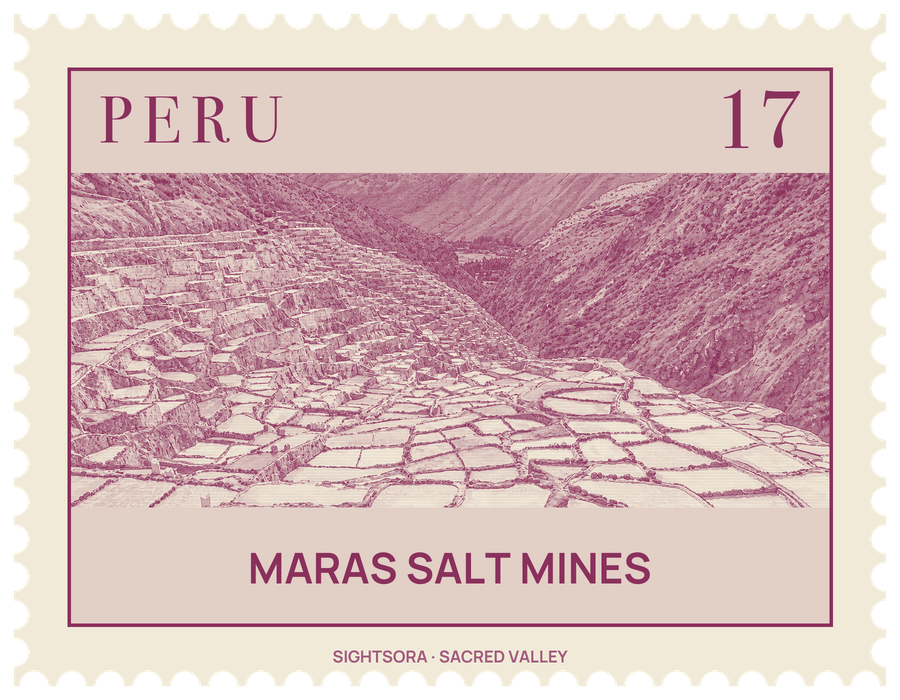
The Salt Mines of Maras, the Salineras de Maras in Spanish, are a salt works of pre-Hispanic origin that has stayed in use through the Inca, colonial and republican periods to the present day.
There are about 4,500 wells, each roughly five square metres in area and thirty centimetres deep, held in place by retaining walls of rough stone and clay. A salty spring at the top of the slope feeds a main channel, which divides into smaller channels that bring the water to every well, so the whole hillside is threaded with narrow watercourses running between the pans.
The salt is gathered once a month. The wells are flooded with spring water to about five centimetres and left to evaporate for three days, and the cycle is repeated until, after a month, the salt lies several inches deep. Workers then break it up by hand or with pickaxes, lift it out in small chunks and let it dry before it goes to the Marasal warehouse. The top layer is sold as kitchen salt, the second as bulk salt and the third for industry or farming. In the dry season the salt builds up faster and comes out pink or white; in the wet season it gathers more slowly and is often brown.
The pans belong to around 400 families and pass down through the generations; a pond may only be sold to another resident of the villages of Maras or Pichingoto. Excavations in the area have turned up pottery of the Chanapata, Killke and Inca styles, and 16th-century records name descendants of the Inca nobility among the owners of the wells. Since 1980 the salt trade has been run by Marasal, a company owned by people from Maras and Pichingoto.